
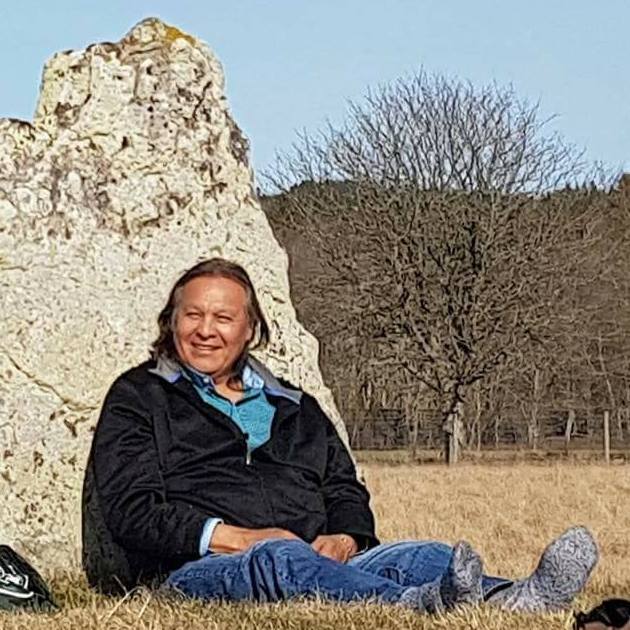
In this conversation revisited, Tiokasin Ghosthorse shares how modern industrial society has disconnected from the ancient intelligences that surround us, and the pain of this forgetting in the rush towards progress. He reveals how we’ve replaced relationship and intuition with concepts and control, rather than seeking wisdom in the living metabolism of existence itself.
Through sharing stories about his elders, reflecting on what it means to grieve honestly, and the Lakota language, he offers a way back to recognizing that everything is already speaking to us and taking care of us, if we remember how to listen.
Time notes:
[00:07:45] – Lakota and intuition
[00:10:29] – The highest intelligence
[00:16:03] – The spiritual umbilical cord
[00:21:20] -33 intelligences
[00:27:51] – Relationship with time and timelessness
[00:31:37] – Morning ritual of perception
[00:34:48] – Innocence
[00:40:42] – The elder at the creek
[00:46:16] – Language of grief
[00:54:16] – Using energy wisely
Music included is from Tiokasin called ‘Butterfly Against the Wind’
This conversation originally aired on February 22, 2022
~
Links:
Tiokasin Ghosthorse and First Voices Indigenous Radio https://firstvoicesindigenousradio.org/production/tiokasin-ghosthorse
Post-Listen suggested episode with Kunzang Choden https://oliviaclementine.com/kunzang-choden-bhutanese-heritage-dorji-linga-part-one/
~
Rough transcript, please excuse all errors
[00:00:00] Tiokasin: I, I know when I get up, I’m like. Wow. That’s the breadth of life.
And it comes from a spoken universe, unspoken universe. And I drink mini, which is, uh, the voicing of life in the relationship to all things, water, right? And then I get up and I make a fire, the, the fire without in it’s always been been there. yeah. All these things. And then I step on, on with the earth and I’m like, oh, the elements, the comp, the mi, whoa, that’s me.
That, that’s, whoa, this is cool. And so that’s the first recognition.
And then you go outside and you’re like, you could feel in a sense the intuition. What is that tree thinking about me? What does that tree see? It’s all about these other elements already inside of you, outside of you, that are already perceiving you.
So where does your thoughts come from? Oh, they come from the tree. They come from the air, they come from the water, they come from the earth, they come from fire. well this is a great metabolism. Not a miracle, but a great metabolism to understand that this is who we are and why would we wanna forget that?
My name is Olivia Clementine and this is Love and Liberation. Conversations, exploring depth, wisdom and relationship. Today, our guest is Tiokasin Ghosthorse. Tiokasin shares
about using energy properly, the ultimate elder and the forgotten language that truly matters,
[00:02:06] Olivia: Would you share about those who have or continue to be a guide for you? Any wisdom or stories that arise when they come to heart?
[00:02:17] Tiokasin: When, when we talk about, well, let’s be honest, does that mean we, we’ve been lying the whole time? Okay, let’s start with that. Um, that, that expression doesn’t exist in a lot of native languages, let’s be honest, because that means you were lying other time until you say that.
And then does that make you believable? So when I think about, okay, I don’t see, um, how do I say it, but I experience metabolize the elders, the an ancestors, they go out before us to make room for us. ’cause they go first and we must follow them. So, um, in line with where these elders come from, is they were, when I was small, when I was little, when I was just a barely a toddler.
And even on, um, till I was six and a half, it was that ancestors’ knowledge, not wisdom, knowledge that fed me. And I could only speak in the language of Lakota at that time. And, and that was a very much, I would say, not a primal yet. It was initiation into, um, quantum physics, language of understanding the metabolite, uh, energy that we all carry.
and so with that ancient. Relationship rather than connection. The elders who were born in the 1800’s, I would sit in solace with, I say that because it felt like that elder and myself were the only ones in the world when you were a child. You’re like, the world opened up when you were sitting next to an elder because you could see the, the infinite, the, the infinite universe within yourself as a child.
And when we, I would sit with these elders who are not around, of course. Uh, all through my life I’ve had different elders. And what they taught me that the earth is the elder. What they taught me was the tree, which is the oldest. Do we, we say that in our way is, is that the tree is the oldest living ancestor that we have.
And before that was the rock, you know, and the fire and all the elements. So I would say the elders are the elements that we are made up of. And to always respect that within and without as one, rather than the, this disjointed of connecting and inside, outside, there’s no such thing. There’s no borders. So these, these ancestors are always present.
You don’t see them. we have lost the language connection in this, in this society, in this language with relationship with the elders. And so we don’t give that respect anymore.
We are, we’ve removed the spiritual value from the earth and gone into space somehow with that and made a, a dominant figure that looks, looks down from wherever and it’s almost like a child story rather than an ancestor story.
So I think that’s the difference in, it’s a long answer for your question, but that’s what it is.
[00:05:37] Olivia: Would you elaborate on that last line of, it’s more of a child story than an ancestor’s story?
[00:05:45] Tiokasin: So when I say that reference, the, the fairy stories that, the children’s stories that we hear and we grew up with in this society that are read to us rather than experience.
So we wake up with concepts and we’re told in concepts and there’s no freedom within to be in wonderment of our own. And I remember this very succinctly is, um, until I was six and a half, I, I didn’t have a mind. Everything was hard and intuition. And then I was taught what a mind was in, in this mental condition of, of taking instruction rather than being shown.
And so the, the showing processes, you still are able to choose freely what you want to learn, and what comes to you, what you’re prepared. But in another way of being different in a, in a society that you have to teach and instruct and give instructions and directions and mechanically fall into place and linear or linear thinking.
And so this was very much different than the universal thinking. The holistic thinking, that everything had to have subject name and title and objectified and everything. Everything became a thing. And that was difficult for me to understand. And sometimes I still, uh, have under misunderstandings with that because I’m always reverting, I would say my, to my default thinking, my go-to thinking, which is Lakota.
because that has gotten me this far. It wasn’t because I have a, I had, or I have a big account in the bank. Or a corporation backing me or anything like that. It was simply that, from, from that time when I was young.
[00:07:37] Olivia: I’m curious what that looks like when you were young to be led by heart and intuition rather than mind.
[00:07:45] Tiokasin: a few years ago, I asked my mother, who’s 88, will be 88 next month, and she said that, son, we cannot speak Lakota without intuition. And, and I kept thinking about that and that helped me more in remembering the language that I was forced to forget.
And am remembering again is the intuitive value is the elders speaking. We don’t see them, but we feel them. Like we know an elder is a tree and all life, all plants, all. Elements that I talk about, they speak through intuition. And what we do with this language we have that I’m speaking to you is, is to construct concepts.
Um, but we have to have precepts to do that. So we set up assumptions. I think that we will ultimately know everything. And from that is like, where am I right? Am I wrong? And so we get into the egotistical values of what it means to be a human being, or in this case a human. And we value human life over all, all other life, including those elders that we come from.
And so we get become anthropocentric and egotistical as a species in this way, and we’re forgetting the relationship. And because we’ve been set up. To assume that we’re gonna go someplace else after this lifetime, this consciousness here is that we’re, we say we’re gonna have higher consciousness, we’re gonna raise our consciousness, and we never get to deal with this responsibility here of caring for the earth, being with the earth, living with the earth, or at least living, learning how to live with the earth.
And so the, the subjective language tends to materialize everything and takes the energy out. So if I say, these are glasses, right, and that’s English, but if I say, these are glassing, that’s in a thought of Lakota in a small way, that’s what they’re doing. They’re created to be, to be energy.
And that that’s what we identify, or basically that’s what we feel they are. so in, in these ways. Which are very ambiguous to a lot of people in this language that we’re speaking. It’s like, oh, he is not making sense. And, and that not making sense is actually, um, the mystery that’s always involved in what we’re saying, what we’re thinking, what we’re being, and, uh, what we’re we should be living is always acknowledging that the mystery, which is intuition.
[00:10:29] Olivia: Yeah. You said someplace. ” If nature is blocked, then a spiritual maturity never happens, that the highest intelligence is to be one with Mother Earth.” Certainly this feels very connected with what you’re sharing and, and what you’re sharing about this desire to always transcend, like we’re in such a culture of transcending, being in the intellect, the feelings, intuition, body are less than intellect.
that intellect equates to money, power, fulfillment. and it’s just so interesting to me because it’s like on an intellectual level, even so many people understand the emptiness of, of this, of intellect, money, power, fame, um, and yet. Why is it that we still want to forget our original home, forgetting completely the only way we can actually even be here function, breathe.
Yeah,
[00:11:27] Tiokasin: Totally. I, I think that, that’s a great question and thought process there is that I think in, in the western sense of, of forgetting, uh, the roots and stuff, of course the tragedy that has happened to the peoples who have come here and we are still here as native people on, on the land that we were created from with the land.
And when I think about the pain, looking for the pain relief. Forgetting helps that for, for temporary reasons, that we came here to be, to fulfill a, a dream called America. And, and with, without ever remembering, the native peoples are that dream right to show people how to live with the earth. I think that’s the ultimate dream.
but when you come here bringing con constructed ideologies like democracy, like communism, like anything that comes here with the old world thinking that comes out of Greece and, Roman, concepts, those ideas of, of how it is to be free. So therefore, we’re given the, the ideals, the amendments of how to be free, the civil rights about how to be free and they’re human.
And so when we got disconnected, it’s, we forgot about the earth defining us as humanity. The earth nature defines what humanity is and we’ve got into an egotistical elitism with the earth away from it distancing ourselves saying that we’re, we’re more than the earth, therefore we can dominate the earth and we’re, we’re gonna go someplace else.
And what I’m saying is, Olivia, is, is that when we, when we’ve, defined ourselves as what it, what’s humane is, is that the cat or is that the bug we squish or is that something we don’t see over there? The native people who are trying so struggling so hard to, to maintain a sustainability of a hundred thousand years of culture and now we’re, we’re, we’re idolizing or worshiping a barely five to 6,000 year old cultures coming out of those places like Samaria or other whatever.
And those are child, those thoughts are childlike somehow. ’cause they’re based on. Nouns, dignifying material gain, and therefore our intellect is, is from that. So I would, I would say that understanding how not to think, you truly know where thinking comes from, intelligence of the heart. that’s the, the intuition of the heart.
And so it’s a very different way of being and it’s not a trendy way. And that’s what we run into in, in modern day society. The trendy way to describe, how do you say, hospicing, this modernity, you know? So we’re trying to relieve our pain by, by forgetting, you know, what we’ve done to the land, what we’re doing to the land, what we’re doing to the native people, what we’re doing to ourselves.
By it’s easy. We’re looking for the convenience, the bodega on the corner to get this pain relief, roll on or whatever it is. And, and, um, I think the, the terms are so trendy that it, it’s like we try to make up new psychologies for the pain all the time, and that, who’s that based on? Or maybe a couple of, white men in the 18 hundreds, Freud and whoever else.
Uh, that’s where we’re basing our modern day. Let’s get, well quickly, find it in the book. Go to this retreat and we’ll be okay temporarily. But we find ourselves wanting more. And so it’s not, it’s so self-centered that the center has become empty now, and this may be harsh words because why, why hold any punches?
Why beat around the bush anymore? And I think it’s required that we tell the truth, not just try to do our best in telling the truth. But we must earth, the earth is requiring us to tell the truth now.
[00:15:37] Olivia: Yeah. It brings to mind the, the topic of vulnerability and talking about trends
there’s such this interesting trend of, as if vulnerability just came about like this, you know, it’s so important to be vulnerable with each other, and yet we forget this vulnerability with the earth, which is what it sounds like you’re speaking of too. Like this exposing ourself, that brokenness, that tenderness to the earth seems so important right now.
[00:16:03] Tiokasin: Yeah. That it is. And how do I say this? This, um, -, um, we are very pitiful and we don’t understand, and we become numb with our own tragedies like trauma. And I know that’s the, the newest, one of the newer things and we only make. It’s like americanizing yoga, when the yogas are not stretching themselves and distorting themselves.
The yogi, the yogi are sitting in one place being, being yogis, practicing yoga. So, you know, there’s a, there’s a disconnect from, from that originality. And you, earlier you ask, and, and that’s the pain, the, the, the separating from the earth. Our, our spiritual umbilical cord is we separated from the earth and now we don’t know how to find mother anymore.
So we kind of shun her every time she reminds us that you belong to me, if that’s an ownership, mentality. But it’s, it’s, uh, really we do, but that’s what we’re made up of. we’re made up of the stars too, you know, and so that’s too big for a dual dualistic mind. It’s too big for cause and effect.
That’s too big for, concept of time, beginning and ending. That’s too big for hierarchical thinking. The top and the bottom. It’s a box. It’s a pair of box I call it. I think that’s where we have to understand that there are other languages that, that can’t fit, within the language we’re speaking now.
And this is why we are compartmentalized as native people put on reservations, were all out of the, out of mind, out of sight, uh, these little blocks of land on the whole continent with native people so that we’re not really involved in the so-called American society or culture at best. I think now the young people like yourself are starting to sense something else is going on.
Like there’s uh, no need for a new narrative because the narrative is earth. But our intellect will listen to all the, the well-educated Western white males and women who. Speak of these concepts so that we could feel better about ourselves, then that requires more writing, more books. You know, we don’t see, oh, we’re, we’re cutting this, this, uh, tree down to make all these books.
And I think I, I’d share this story right now, that they have these native people sitting there and the Creator is talking to us, right? Were talking to us and along this river and this beauty in, in her. And, and then we, we look and we see a ship coming, and we look at it and they get out and they, they chop all the trees down and they build it a, a building in the middle of all the, the trees being devastated.
And all the people go in and then they say they talk to God, right? And we’re wondering, right, God is the creator’s talking to us, but they are talking to God. But they’ve chopped God down. So there’s a, that, that disconnect from nature that came here. And that’s what the, the young people, I think are, are willing to, not as an alternative, but as a native way of being before, uh, western thinking supposedly evolved everybody.
But it’s part of the evolutionary process, right? And it’s not like getting better, uh, and leaving things worse. That’s not a process, that’s not evolutionary. Neither is it leaving the earth. evolutionary is understanding that the earth has known what we need all the time and answered every prayer, every, every want that we wanted, that we asked for as humans gives us air
and we take that for granted, gives us food, we take that for granted, take water. we take all of this life that’s been given freely and then we package it, then we give it to each other, saying, okay, you know, this is why this society doesn’t know what being free is, or freedom it gives it to you
civil, civil liberties. Right. And in the, in the truest sense, there is no word for free in our language. ’cause that’s what we are. So it’s always that we are wild and I accept that I’m not gonna be, you know, giving things out in a, in a very restrictive, dualistic language and say, here’s the answer.
Right or wrong, good or evil. It’s impossible for us to think that, be that in, in many Native Nations.
[00:20:49] Olivia: Yeah.
I’ve heard you actually in many interviews, say like, you speak in circles, not in lines or something. And I don’t function as well in lines, but I think so many of us have, you know, we’re taught that we’re not intelligent if we can’t answer a question just in this particular way, in this particular form.
And it gave me a lot of permission just you constantly mentioning that when you’ve been doing discourse with people and just holding that space, allowing yourself to go in the way that you, you wander,
[00:21:20] Tiokasin: Yeah. It, it’s, it’s no agenda. No agenda. Um. During I, the example is, um, during the onset of, of this intelligent being called COVID, I was instructed by these elders to, to hold 33 fires in a row week after week. So it, I began in March of that 2020 and ended at sometime in early November.
I started by myself and then friend joined and another friend, and then at the end there were about 40 of us and no agenda. It was so foreign to those people who are trying to find a healing formula and they were wondering, well, what’s a fire about? And like, thought about anything and they couldn’t get it.
’cause it wasn’t structured, it wasn’t conceived, it wasn’t. Something they could take, take back and put on a refrigerator and get approval for meritorious valor or whatever that is called, you know? and so like no, the, the fire called, the elder of the elders said, this is how it’s going to be.
I’m gonna give you intelligence. And out of that, from what I understand is there are 33 that the elders said there are 33 intelligences. That the humans, the humans, not human beings, the humans have forgotten that they were once human beings that made them human beings. So 33 intelligences that we’re missing about how to live with the earth.
Right? And so that’s, that’s what, and I don’t have the list. ’cause that’s a no agenda list. I think just the energy of that, I think we come to understand. Like, wait. Now there, there is an intelligence within what’s been given us to wake up and, and really start living with the earth and, and appreciating the fact that we are here and we’re supposed to be here as free people.
And, and all that means is responsibility. You know, responsibility for the earth, responsibility for all life. And the technology that we’ve had, humans invented that. Humans invented technology. And I was asked the other day about, well, you can use technology in a good way, in a bad way. And they wanted to have one over me.
I guess I would say that, well, you use tobacco, you can use it in a good way or a bad way. I said, well, as far as we are concerned, until the Westerners came here, we’ve always used tobacco in a good way because we understood the balance of that. We never put it in our lungs, you know, and all that. We’ve always used it in an appreciation.
And we knew the intrinsic energy value to earth and why that particular herb came to us. And I said, well, you, you come from a place that technology was invented and look how much you hold that up. and they rationalize it from then on. And I said, well, the difference is that humans did not invent tobacco.
So it showed us a way to, to live with them and, and, and appreciate the value of other beings. And already here before we as a species, young species came here, that we are in fact the most ignorant of all the species here. You know? So I think the humbleness, the vulnerability you’re talking about, I think it’s haughty in a sense.
I think it’s another way to describe. That we don’t want to be hurt anymore. So I’ll take this next prescription subscription of a retreat and, and that pill or whatever in, in the society, or go to that, uh, ceremony, ayahuasca or whatever. These things are going on. And so these, and in the native way, it’s like, wait, just one person takes it for all of ’em because that person knows how to use it in a good way.
And that’s not a medicine person or what, but that elder who, who who’s able to take that medicine is, is able to, to understand these other worlds and find what that person who’s ailing needs, um, this plant or that plant. And that’s how it’s done. But here in America, you’ve, we’ve, yo yoga ized, that’s a word we’ve Americanized, uh, ayahuasca.
We made it available to everybody. Only the rich can can have it shipped in. You know, it’s all these privileges to think that we’re all medicine people, right? And it all going up to the egotistical mindset, and I think it’s part of the torture we do to ourselves. We, I think it’s Latin. It says, um, fellow -, meaning to commit a crime against self.
We are committing suicide. You know, in this way we’re not even understanding our dictions. Right? Or, or because of a one loss inside. We’re trying to fill something by accumulating and the privilege of being able to buy and going back to their formula. So, you know, the difference is that we, we have stopped, stopped making decisions, uh.
Through the earth and, and continue to make ’em through the bank. We don’t know what we’re doing to ourselves. ’cause we’re, in the greed of it. We’re in the, the taking. Too much of it. The, we’re taking too much of everything. Even thinking information, it information glut, it’s greed. I have to know.
I gotta know. I gotta know. But yet people begin to know, and then that information changes, right? But the earth and the sun and truth always rise. As my Elder would say, those three things rise. And any human’s life is the sun, the moon and truth. Those things always rise. And right now that the sun has been being truthful, faithful, if that’s the word, and so is the moon.
And now truth is rising again. And that’s what we have to look forward to.
[00:27:51] Olivia: Yeah.
[00:27:54] Tiokasin: Oh, there you go. The circular thinking.
[00:27:56] Olivia: Yeah. I love it so much. Um, there’s so much in there too that it’s really, touching and, you just speaking of the fires and, and people wanting to know what the purpose of those fires is really striking to me, the sense of time this, the relationship we have with time in the modern world.
This like, what am I getting from my time and even in ceremony, what am I gonna get? And I’m curious, from a Lakota perspective, how is time related with like the beginnings and endings or all I’m curious your perspective on time.
[00:28:35] Tiokasin: Well, I’ve been told that, you know, originally there was no need for time. and so we had to adapt or yeah, adapt to the concept of what time is and.
You hear from that Western perspective, the colonized perspective. Well, how did you count the seasons? Why did you keep history? You know, winter count and all these things is because we had the influence of, uh, the Westerners conceiving what time was according to labor, you know? And, um, so in the continuum, if your universal thought processor and your calendar, so, so to speak, is the Palladian calendar, um, not a Julian or, or a Gregorian or even a Jewish calendar, any of these calendars at perceived time as this concept of control.
And when you come from the universal, way, then how big is your heart rather than your mind? ’cause your mind conceives of time, concepts and inventions to get whatever we need to get through this, this, uh, dimension. Um. The time really didn’t exist. We always say time immemorial, and we say, how long we’ve been living here with the Earth?
And we say, time memorial. You don’t remember that because time didn’t exist. We’re in a continuum always going, not just in the future or the past, but always being here, but never being here.
So these are all time concept. Oh, the future, the past and now. And so we must always think in, in a western way of saying, well, the past and the future.
And now, so a contu basically means that the, the being from the ancient future now, but if you’re on a continuum, there’s, there’s no need for time. ’cause if I could say it’s eternity, then that’s what it is. Yeah. And so we’d rather recognize at what point we are on that and seeing and acknowledging the energy.
Within us as well as what’s going on in the universe. So these are, um, you know, could be way out their thinking because they’re outside the box, and people are like, ah, we don’t wanna believe that. We have to write this down to, we wanna present this to a class. We want to, you know, it’s all always trying to take all of that beautiful knowledge and ancient wisdom and put it into, you know, a something that we can, a container, right?
And all this time, the container never existed in the first place.
[00:31:22] Olivia: Yeah. When you’re walking through the world from the perception that you have, how do you perceive the self? Like, who is the one that’s perceiving when you are in life?
[00:31:37] Tiokasin: I, I know when I get up, I’m like. Wow. That’s the breadth of life.
And it comes from a spoken universe, unspoken universe. And I drink mini, which is, uh, the voicing of life in the relationship to all things, water, right? And then I get up and I make a fire, the, the fire without in it’s always been been there. yeah. All these things. And then I step on, on with the earth and I’m like, oh, the elements, the comp, the mi, whoa, that’s me.
That, that’s, whoa, this is cool. And so that’s the first recognition.
And then you go outside and you’re like, you could feel in a sense the intuition. What is that tree thinking about me? What does that tree see? It’s all about these other elements already inside of you, outside of you, that are already perceiving you.
So where does your thoughts come from? Oh, they come from the tree. They come from the air, they come from the water, they come from the earth, they come from fire. well this is a great metabolism. Not a miracle, but a great metabolism to understand that this is who we are and why would we wanna forget that?
You know? Why do we say it’s a prayer? Because that’s a container. No, I mean, think about no religion and like intuition could be that And you know, I go outside almost every time this, this either an eagle or a hawk appear and I’m like, you know, saying, hello, this is good timing. Uh, I can say all these things like that.
And I just like, oh yeah. Ah, and I recognize I even when I’m driving in the car and there’s a hawk sitting on the telephone wire and everybody, cars are just going by, I slow down and I honk and I acknowledge you. And that hawk just looks right at me. ‘Cause I, it feels that energy, things like this, you know, the little we can give to the earth is, um, it, it lessens the pain of taking, I guess humans.
I don’t, I don’t think we know how to give anymore. We as Lakota, um, an elder said that, we’ve given everything as native people and not to make people feel guilty or anything like that. We’ve get, and everything’s been taken from us. But one thing that we, we don’t have anything more to give. That’s when we truly know how to give, is when we don’t have anything to give because it’s all been taken from.
So, I, I learned. About, wow. That’s, that’s what we are in, in the ultimate is the energy that can’t be given, can’t be taken by concepts, control guns, drugs, behavior, addictive behavior. Um, anybody who thinks they can dominate. And that’s the other thing is that the word for domination or the concept of it doesn’t exist in Lakota.
[00:34:48] Olivia: Yeah. As you’re sharing about your relationship in the morning, the the breath of life, the fire, the earth, air, would you mind sharing just even a, even more, about each of those elements and your experience with them and anything that arises in relationship to each.
[00:35:08] Tiokasin: Each of those elements has a creation story, so to speak. And, and if we, ’cause I’m speaking this language, that means, well, when it begin, when it begins, when did it begin? But I can only use this language in, in the sort of broad, broader way. the context of creation is that every moment is innocent. And what makes us innocent without guilt is that energy is always present.
Energy is always innocent. It’s what we do with it. And, and what did we do with water? What did we do with the elements that I described? What do we do with that? Do we have, we lost respect, and, you know, paid attention to Western environmentalist and said that recycling is an answer or alternative energy is the answer.
Renewable sustainability. And, and all these are concepts like, like this is how we look at the water. This is how we look at ourselves. We’re disconnected.
So we want to describe things in temporary pain relief, um, without ever understanding, like climate change, right? We climate crisis, climate warming in the nineties when I was younger and, and all these things that were being said then I’m like, wait.
But the elders are saying it’s grief, always been grief. and how to speak that language of grief is, is lacking. ’cause it’s being, it’s very selfish. It’s a concept. so when I’m thinking about, okay, these, these, what’s been faithful are the elements, and they want us to recognize the grief that, that maybe they’re pain because they can’t
come as pure as they they did before ’cause of what we’re doing with our thoughts. and I think, the creation story of each of those elements are actually the creation story of us. We’ve taken over creating and using what literally imagination that is. we’ve lost a proper use of energy, the proper tools of relating with the earth and or even ourselves and other human beings.
And we’ve come up with the easy answers of walls and wars and proper especially, and ownership and self-centered. I and me and my, and mine and ours, we’ve come up with that and ’cause it’s easy, easier to speak a, a language that that is disconnected to the earth because that means we have to be responsible.
To the Earth. So we come from the earth that we as native people can’t go to the heart. ’cause that’s where we come from. And so in the Western world, you say, well, you have to go to the heart. It’s centered in the heart. And I’m like, wait, no, it’s, it’s the other way around. We come from the heart and we go to the mind.
It’s always the center here. The, the Lakota. Yeah. It’s always about coming from the heart, the Chante, the Tree of Life, the tree of truth, and all these, um, you know, the, the concepts of mental intelligence is that are centered into intuition right there. So, it’s like I can go into a meditative state with other people and, and I hear them thinking, I’m like, wow, that’s noisy.
You guys are all noisy, man. Let’s, let’s not think, leave the mind and actually understand a childlike manner, innocence from the heart and stop with the concepts. Stop with owning. Stop with information. Just stop thinking. Let the heart do that. Let the earth save you rather than you thinking you can arrogantly, dominate and save the earth.
’cause she knows she’s been here for who knows. How much longer do we have as a native people, as people understanding the native? It’s familiar, but generations, I’d say maybe 200 generations that, the Westerner has been away from themselves and that came here and I’m maybe one generation away from that.
And so I’m gonna refer default to a hundred thousand not the one that came here. 500 years ago.
[00:39:50] Olivia: Yeah. Hmm. And just speaking of expression, you’re certainly someone that is able to express in so many different ways. Like you, you know, you’re a musician and play the, the Lakota flute and you have a radio station that’s a conduit for indigenous voices.
And, um, just your general understanding of language, feels very, well understood, in terms of even just the western language and the roots of that, and then of certainly, the Lakota language. And, you know, you’ve also been through severe traumatic experiences in terms of the reign of terror and missionary schools where your mother tongue was literally tried, to be removed from you fully.
Um, what has happened in your expression through that time? The journey of, of this expression, this Lakota,
[00:40:42] Tiokasin: I always, um, nice and I thank it reminds me of, of the, the people that have helped me and recognize where I was in my lifetime and that journey started with them. And the first time I, I was described to who I was is when I was about four my father had left he journeyed on. And, um, I didn’t know what it meant, meant at that time to not have a father.
Right. So I, I spent some times down in a creek bed with a, some sort of a enclave of, of walls of a creek, maybe 20 feet high around me. And then the, the creek itself. And a little sandbar, so to speak. And, and I, I sat there and just sat there and was watching the, the reflection of the, the birds mag pies and woodpeckers and just playing in, in the, in the reflection and the trees above.
And I was like, so wondering what? There’s another world I look up and there’s another world. I was always in that phase. Maybe that was my, my transition to accept my father was, was gone. And I didn’t know, um, maybe that was the impact. But I was sitting there and I heard crunching and behind me around the creek bend.
It came an older man and he, his shirt was all ragged. Uh, he had like, um, leggings on of the native person with moccasins always worn. He was worn and torn basically, and his had lines, deep lines in his face. And I watched him and I wasn’t afraid of him. He came up and he looked at me and he bent down and grabbed the sand and he, he took it and he scattered across a reflection of the pool and he said, this is who you are.
And at four years old, you’re into like the circles that are hitting the, the water and all these circles appearing. And I’m like, this is who I am. And I saw the stars in that way, and this is four years old. And then in an instant, I looked up and I didn’t see him go. And so that defined me, to understand that no matter who it is along the way, I will be, if I refer to the elders that have, are showing me the way such as the Earth, first of all, in this case, human elders. I could also take reference from them. And along the way, my father would come through them because the recognition was in, in me also, that I was my father and never leaving that alone. And I think the trauma, not the, the, the drama of it, but the trauma is that you can’t make that up because if you make up trauma, it’s gonna hurt those who actually are having.
So, when I thought about it, oh, you know, from that point on, I had trouble trying to adjust into the society with what they were telling me, what trauma was all about. And yet we have a ceremony called, uh, wiping the tears that I didn’t get to go through until I was in my thirties. but Those times of, of trauma at that time were, were often described to me from the society. But yet why did all these events in my life, these elders come forward was to fill me in, to help me to get to this point of, the, wiping the tears ceremony and understanding that I was, being prepared for this time.
I was being prepared by the elders who are out ahead of me and coaxing me on. So earlier in this little discussion, a doctor from Pakistan, Maji, I think his name was, he in New York City, saw me and he said. He said, do you know what I love about you Tiokasin? And of course I’m saying, what? And he said that you never give up.
You never give up. The voice is not just your own. Like, and he recognized that being a Pakistanian Pakistan. Yeah. From Pakistan. Um, he understood the struggle that they are going of going on over there with religion impending and dominating, and the, the real people just wanting to be free to live with the earth.
Because what we get is the fringe, uh, layer on top of what news is all about. But we never hear about the people in the jungle, in the desert, in the mountains struggling to live with the earth. And I think that’s been my mainstay all this time. Olivia is, is really struggling to live with the earth, which I said before is the, like the highest intelligence.
If that’s a, a way to think about it. so I think that’s what has helped me go through all this trauma, not to make it up. ’cause a lot of the people want to make it up so that they can have attention. Um, yeah.
[00:46:16] Olivia: There’s a part of me that wants to know how to grieve in a way that’s honest.
[00:46:22] Tiokasin: Well, good way is another elder of mine currently, said that, we, of course speaking a different language helps, but, how do I say it? Is? He said something like, that if you want to see the results of your work during this lifetime, then you will never be worth the people that you come from.
Because if you don’t have struggle, right. You’re never gonna know who you are. And if you’re just gonna come from this worry wart up here, that’s not what that’s for. Right. And if you give, what you’re taking from the earth rather than as a given reward, it’s like, no, just give to the earth. ’cause you’re doing it for the seven generations ahead.
Right. But you have to understand also, Olivia, that you are the seventh generation and each generation is the seventh generation. You see, not just some place to go have a goal, Or how do you say it? A, a goal and solution that we’ve, we’ve gone far away from being ourselves by accepting a goal.
And we must achieve, we must have a goal, we must have a solution. And that, that’s the cause and effect mindset, duality of the west and. And forgotten about how to think multidimensional, uh, with the earth in the quantum physics way. and, and so we don’t have the language, we only have noun fulfilling, which really isn’t about filling anything.
It just temporarily taking space until it’s gone and the next trend comes. And yeah, it sounds all critical that I’m saying. but you know, like before I wasn’t. I was just being me and no one liked what I was saying, but I’m sure certainly not gonna be a performance native performance in Indian, um, sing to anybody, uh, a ceremony song or pray for anybody.
It’s not that way anymore. It’s with the earth. What are we doing for the earth, you know? and it’s difficult, especially for native people to try to be ourselves, um, because we don’t have the freeness of land. And so we’re, we’re materially poor. and I understand it as we’ve made poverty for indigenous peoples.
When they weren’t poor, they didn’t understand what poverty was. No, rich. ’cause they didn’t need to be rich. They have the earth. They have the earth. And now we are, we’re doing the same thing to the wildlife. The animals, we’re making them poor, they’re disappearing. It’s like indigenous peoples are disappearing.
and I think about the world without indigenous peoples, so without animals and all we have is technology and that’s not gonna last very long. So I think, um, you know, some people say, well, Tiokasin, don’t you think romanticizing indigenous peoples? And I say, well, you’re coming from a different point of view.
I say to that, well, if you think we’re romanticizing indigenous peoples, then what’s the alternative? Do we continue romanticizing western ideals? You know? And, and it’s like, okay, is there an answer? No agenda, follow, follow the earth. Uh, in a way that’s the only way we can do that. So in, in a traditional way that I was brought up, and, and it’s good way without having you speak the language so much, but in and out of that trauma, I’ve learned that, um, it’s, it’s, it’s really not that good to be a follower.
It’s not that good to be a leader. It’s always comforting, being comforting to be with, so neither leader, a follower, but to walk with, be with, in that context. So, By the way, the, the age difference disappears and the energy is never aging. It’s always ageless. So when I talk about innocence, that’s what I’m talking about, that we all, maybe this body is slowing down and ready to go to someplace else, but so who’s not, you know, when people say, well, you’re only young once TIokasin, I said, yeah, and you’re only old once too.
You know, so how are we, why are we so youth driven? You know? It’s like, because we forgot the elders, you know? It’s all about looking good and beautiful be because when you’re young, you can’t be that you’re being cute. But when the old like, ah, image is not there anymore, we don’t see the inside anymore.
The what we’ve forgotten the -, um, memory, I guess I’d say, but is the acknowledgement of the relationship, like in, um, like in the, the voicing of the living relationship between you and I and all things that’s constantly ongoing. Mm-hmm. We forgot that, but we really didn’t.
We just have to acknowledge that memory. Right. And then the memory becomes instant. So it’s about now what are you doing now? What are we exchanging energy with them? Without being new agey about it, I’m not gonna refer to a crystal or a book or even another human being. I’m like, the earth is always telling me, always like, whoa, you know, when I really get down to it, I’m able to take the concepts outta my head and stop making it all about me.
Then it’s like, wow, the whole world opens up. Mm-hmm. And the whole universe opens up and it’s like, you know, this education of the West is just try to take the wisdom out of me. Give me information, and, and you learn by rote and linear and dictionary and excite, and this is the way you learn it because it gives you a slot within the system and access to the privilege of, uh, attaining more money or something like that.
This other way, it’s like, okay, how tiny is the earth? And we don’t even know what humility or humbleness is all about anymore because we’re, told for centuries now that we are better than the earth and this is why we’re getting sick. We are not, we’re not acknowledging the intelligences that are coming tell us, like, pay attention.
Let’s do this again. Instead we’re fighting it, considering it the enemy. And that that’s, that’s for stupid people. It’s like, I always acknowledge in this case the good and the bad, but it, it’s acknowledge that there is something more intelligent than we are and they’re using their intelligence in a good way, in a proper way.
And we, uh, are just still learning that. And we have to relearn that fast. You know, a crash course as you, you might, might think, but we have to do that now ’cause. I’m not a gloom and doom, but I am optimistic about that something has to happen and will anyway. Um, and those who are still in relationship with the earth will always not talk in connection language.
Yeah.
[00:54:07] Olivia: as we close our conversation, make our way towards that, would you share what your thoughts are on using energy wisely?
[00:54:16] Tiokasin: Yeah. Let’s, let’s go with the word magi. Imagination, you know, imagination. We can go, I am magic nation, I guess for tongue in cheek thought process. Um, stop using adjustable philosophies or, or adaptable, or chitchat philosophy. Stop using, adaptable prophecy. You know, we can’t ever do that. The earth is always going to lead that. So when I’m thinking about energy is, uh, that look at the earth, for example, is, uh, the, the bird.
A bird is using the energy of the earth properly. the wind, the air, right? The tree is using all the energy and the, and the energy in a, in a proper way. And giving, always cycling, recycling, always giving, giving in that way, metabolizing the salt. So I think it, it’s in recognition of, of the words, the language we’re using.
cause you, because language is and energy. You’re using it either properly or improperly, and if we’re gonna stay within this material, thought process. And I think that’s the end of those peoples who are constantly distancing, distancing themselves and still that, and I consider this language a bypass language because it’s intellectual.
and it’s based on, again, 5,000 years of 16 years ago, 66,000 years of 6,000 years of Western, uh, processing. and I, I do, well it’s feeling, that the language is key. And I’ve always said this because we use it, the first thing that we come from when we come into this dimension from our mother’s womb.
So it’s the first language we use. Right? And then. Always reminded of something I heard years ago, um, that language, the first weapon drawn in conflict is language. And we haven’t learned how to use that properly. And I think that that would be one of the keys, to learn how to take, to be non agenda, uh, without how to instructions.
So maybe we just have to stop asking how to do something ’cause that’s still instruction and tell me how to do something so I can get it quickly. Right. So maybe just hearing it and Wow. So go to the earth and observe how she listens to us. Not how well I’m gonna go to the earth and I’m gonna listen to the tree and I’m gonna listen to the birds and the wind.
We don’t even understand that language. So who are we think that we can make a park out of it. You know, let, let’s go to the earth, go to the center and learn how she is listening to us. She listens to everything, you know, in balance. She gives us the air, the, the water, the food, the, yeah, all the senses. But the first and foremost, she gives us intuition.
Not listening to our intuition, is listening to her intuition about how she feels about us. What does she think about us? What are we doing for the earth? How much time are we giving to her? You see? So that would be another way of using energy, properly.