~
In this conversation, we sit down in Pharping Nepal with Josh Kinney, a western practitioner who spent over two decades immersed in the living meditation traditions of Nangchen in Eastern Tibet training under some of its most extraordinary masters, including the force of nature Yogi Pema Dorje, and the renowned Lhagen Pema Drimed. You will hear stories of cave retreats, Tibetan yogas, dark retreat practice, and what it means to enter this remotely held lineage as an outsider with devotion and a willingness to keep showing up.
Time notes:
00:00:00 Introduction
00:01:39 First steps into dharma
00:03:24 Eastern Tibet
00:04:12 Putting on robes
00:05:54 Adeu Rinpoche
000:9:58 Meeting Yogi Pema Dorje
00:12:27 Cave retreats and ngondro
00:14:59 Five Buddha family teachings
00:19:13 Sealed retreats with Pema Dorje
00:25:13 Tibetan yogas
00:27:15 Dark retreat
00:30:22 Pema Dorje’s early life and tests
00:36:40 Naked yogi tales
00:39:08 Retreat training style
00:43:23 Lhagen Pema Drimed
00:49:57 Guided retreat stories
00:53:53 Chudlen essence practice
00:58:24 Dark retreat with friends
01:03:00 Peter Galambos as an example
01:04:43 Outer, inner and secret retreat
01:07:00 3-year retreat and serendipity as the way
Links:
Josh Kinney:
Facebook page: https://www.facebook.com/joshua.kinney.524
Instagram: https://www.instagram.com/mcguru29
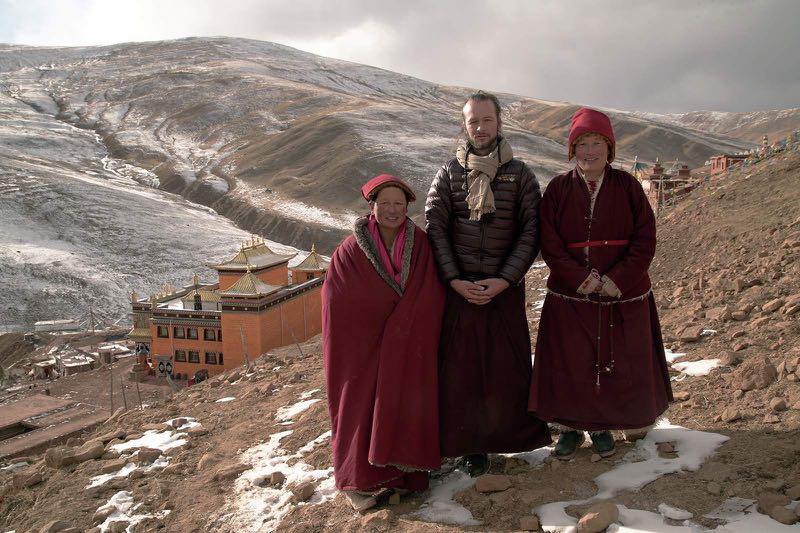
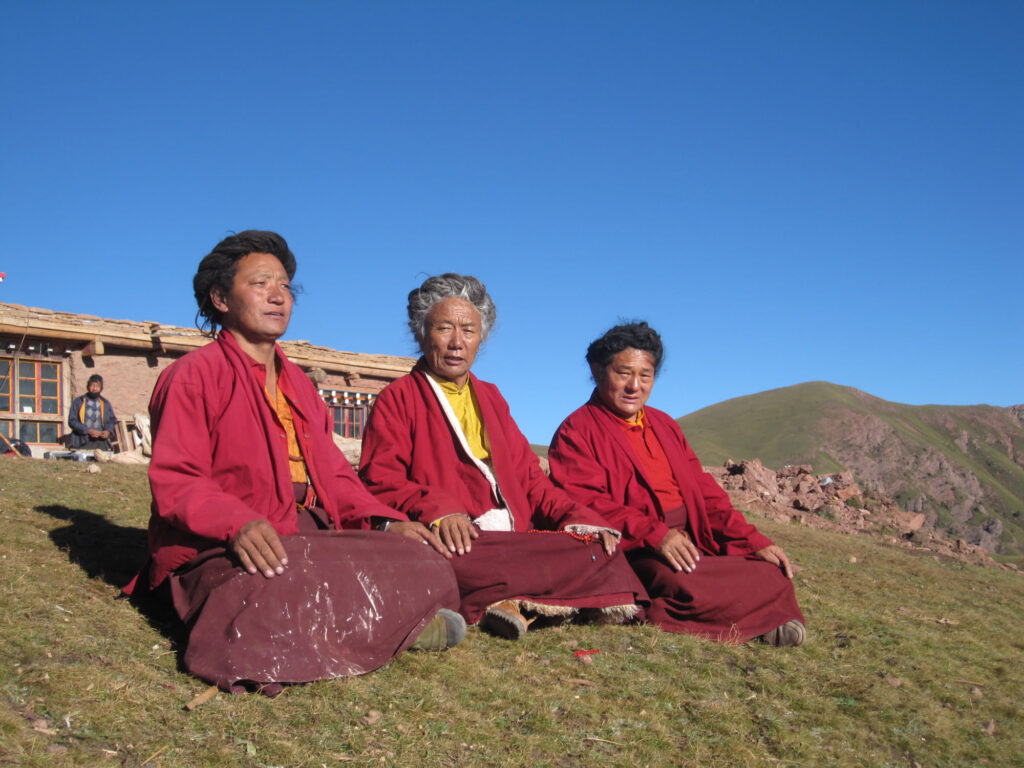
Josh with two of the Gebchak nunnery ritual masters. Image: Hamid Sardar-Afkhami
Support Building a Dark Retreat Hermitage at Gebchak:
In response to Tsogyal Rinpoche and senior Gebchak female practitioners asking Josh to advise and direct the building of this future dark retreat center at the mother nunnery of Gebchak, in Eastern Tibet, Josh is currently requesting support to make this vision come to fruition. This space will be able to hold 15 practitioners at a time and will include bathrooms and a communal kitchen.
You can make an offering here, and Josh will send you a receipt for your gift: paypal.me/gebchakyogis
For questions, you can write Josh: mcreynolds290 (at) gmail (dot) com
Suggested Episode Series:
On the Gebchak Yoginis, a 3 Part Series with Elizabeth McDougal:
Part One: https://oliviaclementine.com/elizabeth-mcdougal-the-gebchak-yoginis-part-one/
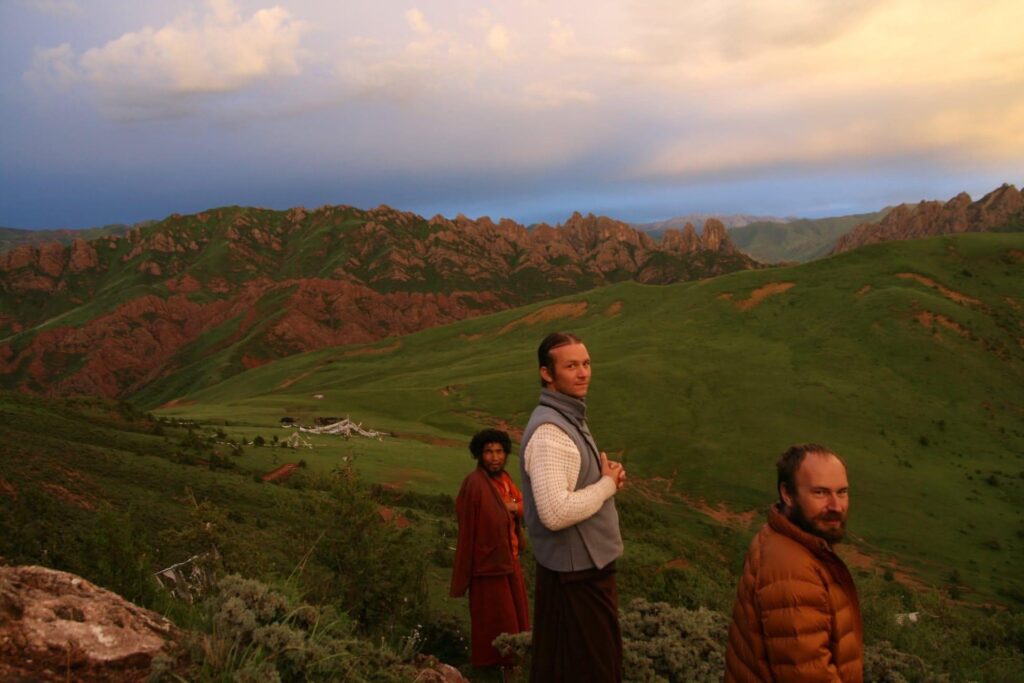
Image: Chimed Dorje, Josh Hinney and Peter Galambos by Arpad Elekes
About Josh Kinney:
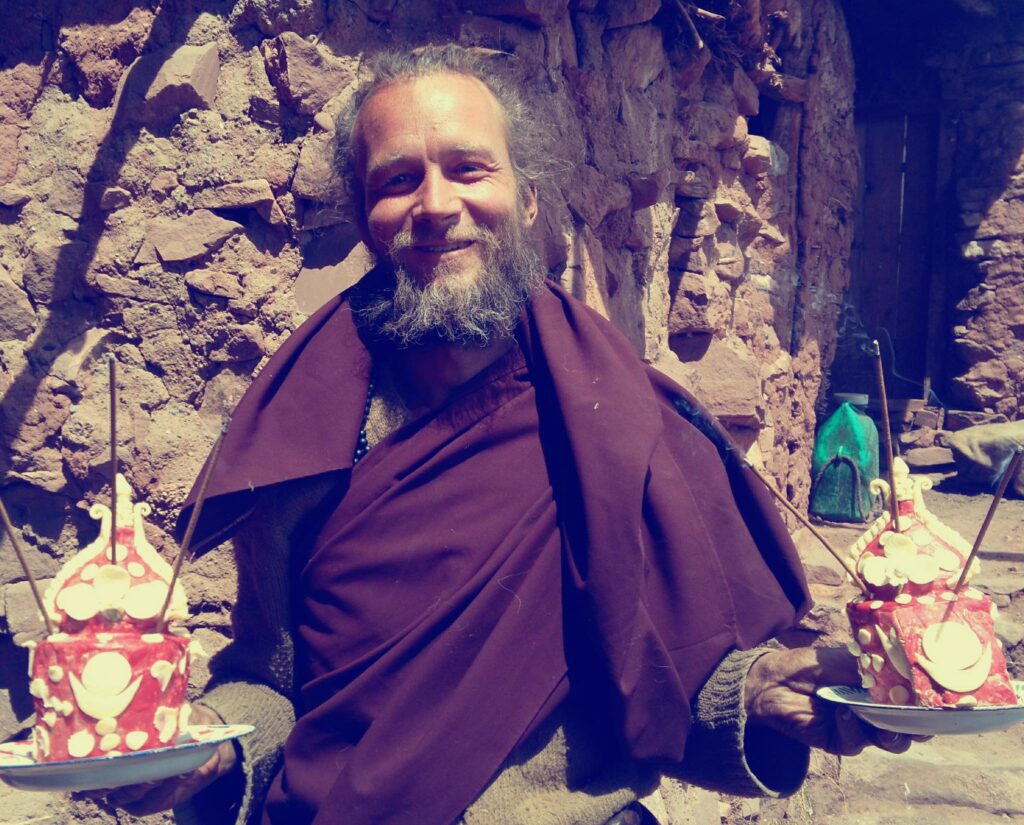
Josh Kinney has been a Buddhist follower for thirty years, since he first saw a slideshow in his parents’ basement in Massachusetts, about the hidden land of Pemakod and the great Dzogchen master Kyabje Chatral Sangye Dorje Rinpoche. Joshua went on a study-abroad trip to Benares, India, in 1997 with his College advisor, Dr. C.W. Huntington, a well-respected Madhyamika and Sanskrit scholar. He was a Religious Studies major and also earned a self-designed Master’s Degree in “Tantra and the Aesthetics of Enlightenment” from Lesley University, U.S.A. Traveling to Kham Nangchen in Tibet with Tsoknyi Rinpoche in 2003, as a video guy, Josh was then a monk for four years with the Drukpa Kagyu master Adeu Rinpoche, before continuing his training with other masters, including Gebchak Togden Pema Dorje, who ordained him as a Ngakpa in 2008. Joshua has been to train with and support his community in Tibet over 20 times, and continues to go there yearly.
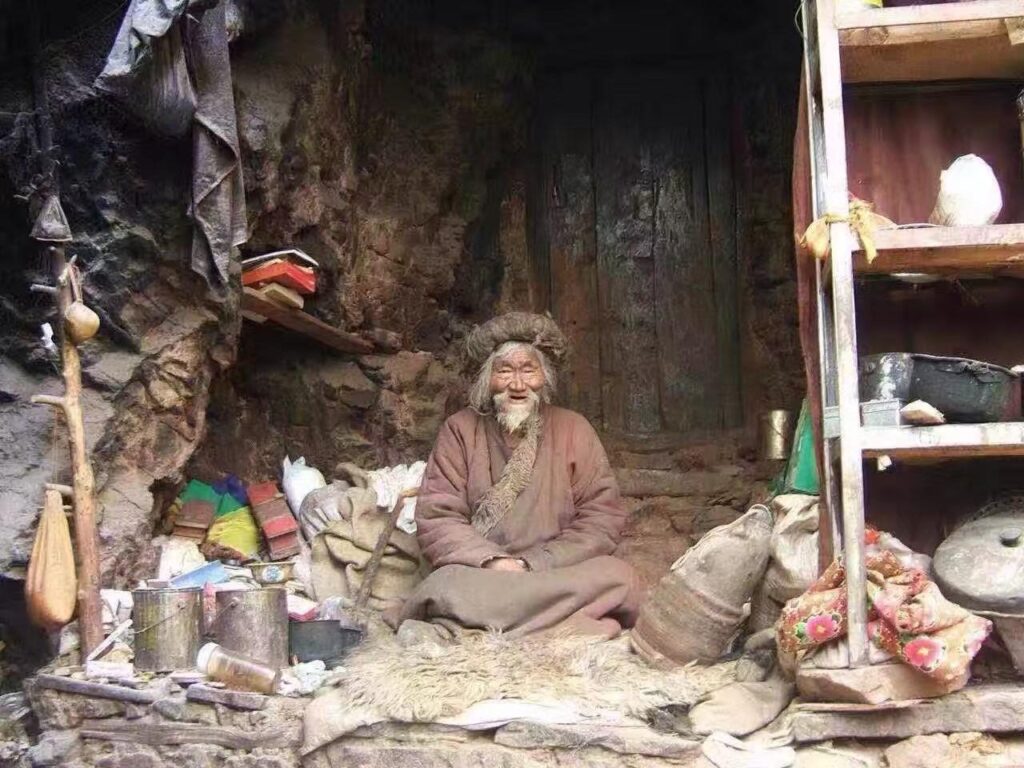
Mahasiddha Pema Dorje at his hermitage. Image: Josh Kinney
Lhagen Pema Primed with two of his close students. Image: Josh Kinney
~
Rough transcript (please excuse all errors)
My name is Olivia Clementine, and this is love and Liberation. In this conversation, we sit down in Pharping Nepal with Josh Kinney, a western practitioner who spent over two decades immersed in the living meditation traditions of Nangchen in Eastern Tibet training under some of its most extraordinary masters,
including the force of nature Yogi Pema Dorje, and the renowned Lhagen Pema Drimed. You will hear stories of cave retreats, Tibetan yogas dark retreat practice, and what it means to enter this remotely held lineage as an outsider with devotion and a willingness to keep showing up.
[00:01:09] Olivia: So thank you so much again for being here. I’m really glad it aligned and we’re in this wonderful, uh, temple space on the outskirts. And, um, so I’m really looking forward to talking about your time in Nangchen, the 20 years plus maybe that you’ve spent there.
And I thought before we begin, it would be wonderful to hear what was happening at the moment you arrived in Nangchen. Were you already deeply immersed in spiritual life? Like, were you a part of a tradition then or what was happening?
[00:01:39] Josh: So when I arrived in Nangchen with Tsoknyi Rinpoche as a video guy, and so that was 2003, but I had already entered into the Dharma through a study abroad program. So in college, when I was a sophomore in college, somehow got the question about who am I? And soon after that, a friend mentioned about a professor who was going to India on a study abroad to, Benarus mm, that was 1997. A month or so before that, a family friend visited, our home and showed a slideshow of Pemako. I’m a bit adventurous, so seeing that kind of adventure and, um, he shared a photo of
Kyabjé Chatral Rinpoche and that really sort of captured my imagination or attention to see this kind of sage like figure, which I hadn’t really had any interest before that in Buddhism or anything much.
After the trip to India, I switched my major from studio art to religious studies.
By 99 when I graduated, I was again, back over in, in India, Nepal. . And then 2001 went on a, a pilgrimage with Tsoknyi Rinpoche in India with a group of his students. And then 2003 was in Nangchen.
So basically I started using a camera and I think that gave me a skill or like, it, it made me more useful for when Tsoknyi Rinpoche wanted to have
the trip in 2003 taped. we went to receive these Ratna Lingpa empowerments from Adeu Rinpoche
[00:03:28] Olivia: And Adeu Rinpoche is one of Tsoknyi’s Rinpoche’s main teachers.
[00:03:30] Josh: Oh, exactly. So the fifth Adeu Rinpoche in the 19th century was one of the first Drupon Tsoknyi main teachers. And so now in that time it was the eighth Adeu Rinpoche. Now it’s the third Tsoknyi Rinpoche. And so Adeu Rinpoche wanted Tsoknyi Rinpoche to come receive the lineage transmission and followed up by a trip to Gebchak Nunnery. So we, we went To Gebchak and a few other of the, hermitages that are connected to Gebchak. I think that trip was a couple months.
[00:04:04] Olivia: Nangchen, we should say, is Eastern Tibet used to be an independent kingdom. Known as the realm of meditators or insiders. And after that, what happened?
[00:04:12] Josh: So then it was more or less move to Asia, live in Nepal. try to go to Tibet as often as possible, but move. I had been in New York for a year and a half, two years,
To be a video maker. There was a Lama who was the head of the Nyingmapa, uh, Taklung Tsetrul Rinpoche. He came through New York City and gave a Lama Gongdu empowerment in 2001, and he was staying with Lama Thupten Phunstok who was just in the same neighborhood where I was living in Brooklyn. Taklung Tsetrul Rinpoche, is just, oh, such a great master. And he was available to do Divinations. So I asked him if I would be able to leave, New York and go elsewhere to focus more on full-time practice. he said in two years, and so that was 2001 and then 2003, it was two years that then the conditions ripened. Then after Nangchen, that first trip to be at the Rangjung Yeshe Institute, that Tsokni Rinpoche was suggesting that I learned Tibetan but also Adeu Rinpoche
So it was because the empowerments were 2003 and then 2004 there was a project for the Ratna Lingpa tsakli , Tsakli are these small empowerment cards that the teacher will use when giving an empowerment that has a painting of the deity. And so we had, uh, old ones, but wanted to, number them and list them, and then sort of doctor them using Photoshop so that job was given to me.
And it meant living in Adeu Rinpoche’s home for like half a year. And so Rinpoche was there quite a lot. at that time I asked if I could become a monk. And then there was another Tulku Tashi Rinpoche from Tare Gonpa, and he is a reincarnation of one of the first Drupon Tsoknyi’s, heart disciple. And he, he was helping to organize this, project that we were doing. And so he brought me to buy robes.
And then somehow it worked out he wanted to like also sponsor a dinner.
So he invited, maybe oh, 30 monks. It was like a big dining hall. Basically it was a, like a meat eating event and he put like the sheep, skull in front of where I was sitting.
the idea was like the day after or so we would be going to Nangchen Gar where Adeu Rinpoche was at that time to, for me to become a monk, I mean, or to try it out or to see what it means to be a monk. there was a sheep had in front of me, and then there was like wine, like I needed to drink wine.
That was part of the, I don’t
[00:06:57] Olivia: Is it like a test? maybe. Yeah.
[00:06:59] Josh: basically we imbibed a bit of the wine and also on an empty stomach. Mm-hmm. Yeah. So
[00:07:07] Olivia: So in like high altitude 4,000 meters.
[00:07:10] Josh: Like I went and they, he brought me back home early.
Yeah. I hadn’t really eaten much that night, the next day we still were going out to the temple, so it was still like, I hadn’t really changed my mind and Rinpoche’s, like his main, like a trulkhor his main yoga, disciple kunchok he shaved my head and tied the monk skirt around my waist, like really tight. I went in to take refuge with Adeu Rinpoche and uh, I had a Hungarian friend, – Peter, who had been living out in Nangchen for like all together, almost like 10 years he was there.
And so he was translating. We didn’t prepare very well. Like we didn’t have a khatag and so Adeu Rinpoche’s attendant was scolding us like. You can’t just go without a khatag, but Peter is a bit informal. But anyway, we didn’t, so then we prepared a khatag and adeu Rinpoche
He gave me refuge and taught for a couple hours. It was really good.
the three of us basically with Peter translating, and then looked right close at me and said, now you are my disciple. What’s your refuge name? ’cause I had taken refuge with, Tsoknyi Rinpoche, so my refuge name is Konchok Jungney, and he said, okay, you don’t need a new one. That’s fine. You can keep Könchok Jungney .
it has a good connection to our lineage because Langdro Lotsawa Könchok Jungné is one of 25 heart disciples of guru. And then he, took a rebirth as Ratna Lingpa in the 15th century. And so then like Drupon Tsoknyi, Tsang Yang Gyamtso, so they rediscovered Ratna Lingpa’s text. So said I didn’t need a new name, but I needed a new shawl because the shawl that we had bought was too short and it had tassels on the end.
he want me to get, a nine foot, like very traditional shawl that you have to fold. And the way to do the skirt. So that was 2004 that continued for four years, but then started to study more learn from Pema Dorje
[00:09:18] Olivia: so what was it like for you being a monk? Was it beneficial for you to be focused in that
[00:09:21] Josh: was very, Very good, The place in Tibet where I was traveling. Like Nangchen, you would be basically in robes if you’re really going to receive teaching and do retreat. It’s not like that everywhere in the Buddhist world.
Of course. but there, it’s like you are really in, and so it’s easier to join the monks for, uh, puja or join for a retreat and to request teachings. Like, because you are as best you can or however you can, you are, you’re showing that you want to dedicate your life, this kind of practice, this kind of way.
[00:09:58] Olivia: I’m really happy you brought up Yogin Pema Dorje. ’cause I would love to go through all of your mean teachers that you’ve received guidance from
[00:10:04] Josh: So he is an old, old generation. He is like this kind of last generation who had trained in Tibet before the Chinese and he lived to be almost a hundred.
[00:10:18] Olivia: When did he pass away? And
[00:10:19] Josh: And he passed away in like January 17th, 2014. And that was, basically it’s
Tsoknyi Rinpoche’s kindness got to go and study, practice, learn with Adeu Rinpoche, Pema Dorje and Pema Drimed there in Nangchen. In 2006 we went to shoot, Blessings
We did the video archive in 2003 and then shot initial footage around in Gebchak and different Nunneries and then with that then Tsokni Rinpoche invited Victress to come.
So then there was a group of maybe 15, Westerners traveling. We went together, we shot more footage, and then we ended up at Pema Dorje’s Hermitage. And then myself and a friend decided we wanted to go back.
So, Tsoknyi Rinpoche wrote a letter requesting that Pema Dorje would teach us.
And I think when we’d also been there the year before. And so he was quite open. Yeah, he was open to teach that was lucky.
[00:11:23] Olivia: When he taught you, did you have a translator or by then, were you understanding Nangchen?
Oh, no. No. So that was the friend, a monk from the uk,
Phil, Phil had been studying. Tibetan and he was fluent
[00:11:36] Josh: But there was, Pema Dorje’s attendant, Chimed Dorje.
And so he could kind of help if Phil didn’t understand. and then a big part of it is just kind of being there in the presence with the lifestyle and learning while learning yoga as well. So of course you need the language,
But there are all these other components and ways that you’re learning.
I remember going back by myself after Phil and I went and not having really much Tibetan at all and feeling very alone, feeling really alone so far away. And not knowing the language, but,
[00:12:11] Olivia: and what happened, how did you work
[00:12:12] Josh: it? Just kind of don’t have much choice,
[00:12:15] Olivia: So Yeah,
[00:12:15] Josh: yeah, luckily you are starting to practice, so luckily if you start to get some experience with that, They will carry you through your hardship.
[00:12:27] Olivia: At that point, you’d been studying Tsoknyi’s lineage essentially. So you were doing the Ratna Lingpa lineage?
[00:12:32] Josh: So when he gave the ngondro reading transmission, that was for the Choling
Tersar like Tukdrub Barche Kunsel’s ngondro which took me, uh, three years to finish. and then there was also was also Adeu Rinpoche who was giving,
Drukpa Kagyu so then I started to, I did a, Drukpa Kagyu mahamudra ngondro up in a cave behind Adeu Rinpoche’s temple in Nangchen called -. I did like the prostration and the vajrasattva there. So
[00:13:05] Olivia: so it’s a big cave
[00:13:07] Josh: Yeah, that one is huge. That one is huge. That one is giant. And there were six other monks there. So it has like a fullon shrine,
it’s a cave with a hut inside it. the mouth of the cave is like 30 feet high and it goes far a couple hundred feet back into the mountain, turns into a tunnel where there’s no light, and then comes out the other end.
And so it gets like a wicked wind pulled through and it kind of faces the northwest. So in winter, we were there in autumn, 2005 or 2006. And the sun was low in the sky. And so it would be in the afternoon from two to four. Some sun would shine in. But that was the coldest cave
That I stayed in. I stayed in about 10 caves, actually, I wanna hear in like 20. Oh yeah. So Nangchen has many Gomde Nangchen, like you said, it’s the gomde, it’s the place of meditation. There are many caves, but you need a cave that has water, like close enough and hopefully it faces towards some sun or maybe not so windy. You know, there are different, different conditions that make the cave I did ngondro
three times. And the third time was for the Tsoknyi lineage.
And I mean, when Pema Dorje taught us, it was also like the core Tsoknyi lineage teaching. I think we had been there the year before Tsoknyi Rinpoche wrote the letter. He said, if it’s coming from Tsoknyi Rinpoche, then I must like give you whatever you ask. And it’s actually, I thanks to Phil, because yeah, that was Phil’s impulse or inspiration.
I think he had a dream actually, he knew what to ask for. So. I was thinking, we just asked for dzogchen, but he asked for this. This is like the core practice for Gebchak nunnery,
so the secret instruction of the five Buddha family, and it’s like a Ratna Lingpa’s.
Sometimes people would call it like the naro, like six yogas of naropa, but it’s, I think maybe just speaking loosely, that’s kind of how one might think of it, but it’s not much.
I mean, there’s a connection because the first Tsoknyi Rinpoche was a Drukpa Kagyu Togden. He had done 13 years of six yogas of Naropa, and then from there he received this Ratna Lingpa transmission from Chodral Dorje, who was a Drukpa Kagyu Togden as well. But then he had this Nyingma lineage, and so then because the first Tsoknyi Rinpoche was such a master at the yogas in Drukpa Kagyu, and he then.
Received the Ratna Lingpa lineage. he could write commentary on the yoga that’s in the Ratna Lingpa lineage. And he wrote a very detailed, commentary on this, secret instruction of the five Buddha family. And it was very interesting because then, so you have like his rediscovered treasure of ratna Lingpa’s practice.
And then Gebchak Tsang-yang Gyamtso, who is one of the heart disciple of Tsoknyi Rinpoche, he also wrote his or commentary on those core practices. And then you have like Pema Drimed’s father, Pema Rigzin, he’s also a main Gebchak yogi and he wrote also from his experience, like his commentary on those practices, it was very amazing. I
[00:16:46] Olivia: You have these three really solid commentary. It’s probably like filling in gaps and
[00:16:51] Josh: As their own way of, yeah, Expressing, explaining, giving details about how to visualize and then, but it’s all built on like Drupon Tsoknyi, Drupon Kagyu lineage. Within Drukpa Kagyu you have so many, uh, like Ratna or Rechungpa or-. or Bawa,
There are many within Drukpa Kagyu and of like of course over the centuries who also mastered all of these yogas.
And then the first Tsoknyi had trained in that so much. So then you can look going, yeah, so you’re right, it’s those, those three masters commenting on Ratna Lingpa’s but then it’s built on what the Drukpa Kagyu had evolved as well. And there’s a lot, like a lot to study or a lot to learn different ways.
[00:17:42] Olivia: It’s so beautiful that you were in an environment where it’s still actively being practiced
[00:17:46] Josh: and we, we are like a part of that. so the, the more we as whoever, like whichever practitioner gets involved, the more it can maybe come out or the more it also gets inspired and gets enlivened. You really enter into the community and so you are feeding each other and you can do it through practice, through just being there.
Uh, through making offerings. I was able to support some of Pema Dorje’s activity for building
a retreat center. So yes, you can get involved in many ways. It’s, uh, you really entered the Sangha entering the Sangha.
[00:18:24] Olivia: So when you were with, um, Pema Dorje, Yogin Pema Dorje, uh, how much time were you around him? Like were you receiving instruction regularly or would he share something with you and you’d go off and practice it or
[00:18:38] Josh: Uh, quite much. I think there, I wasn’t living there full time, but I would go, so like the first time was with the trip. We stayed just a day or two
and and got like a big head bunk from him. And then he is, uh, giving many blessings and aspiration prayers, together with the King of Nangchen. So a small group of us.
Tsoknyi Rinpoche, the king. he is, Pema Dorje is giving us very close blessing. That’s just a day or so. But even then he enters into your mind and you are thinking, how might you go back and learn more? Then I went back with Phil with the letter. That time we stayed for a month and we were up in, uh, one of the caves.
Pema Dorje stayed at one hermitage for 30 years. I think he was there a long time in the main cave, but at that time we were just above his cave for one month and he gave us this the, this teaching. Then the next year I went back and stayed in the Maratika Cave.
It’s on the east side of that, Hermitage, where Pema Dorje was staying. And that was like a six month stay. And then the third time that I really went back to learn from him, then he kind of invited me to stay in his cave. And that was a three month retreat and quite sealed like that one we did in a, like a strict way accumulating the recitation for black hiyagriva.
One of Tsang-yang Gyamtso’s rediscovered treasure of Ratna Lingpa. So for that, we did it strict. It was Pema Dorje he lived on the first floor. And then there’s, this second floor, like a loft. I’d. Stay in the loft, kind of just across from Chimed Dorje uh, Chimed Dorje is the main attendant and like main student of Pema Dorje.
And so then we are with each other quite much, basically eating together. And the, the idea was I wouldn’t see anybody, so it’s more staying in the cave, but then I would need to go out kind of before others had, because we, there is some three retreat nuns nearby. And so the idea was I would defecate kind of off the cliff. Before they were awake and then come back into the cave.
So you would just see him, Pema Dorje and Chimed Dorje. But then it wasn’t because this group of six nuns themselves were in three retreat. So then we end up sharing the veranda of the cave because they were helping to cook meals, and then we started practicing the yogas together.
So it wasn’t very fast. Just suddenly get to stay in that cave was also one that was more like off limits. like within the community, the people weren’t really allowed to go in, but he was there with his attendant.
And then we were, so then I went in for a three month kind of sealed retreat.
[00:21:29] Olivia: Did that happen because you’d been coming year, after year, so then he invited you? Or how did that
[00:21:34] Josh: practice work? I kept coming back to receive more teaching. Mm-hmm.
[00:21:37] Olivia: Mm-hmm.
[00:21:39] Josh: that’s a big part. You just keep going back.
Yeah. You just keep going back and
still wasn’t getting so much like obvious encouragement from him necessarily. Yeah, during that retreat I got a bit, sick and so we sent my urine down to a doctor in the village and he said, oh, it looks now – is getting some, accomplishment from looking at the urine somehow.
I don’t know. It wasn’t much, sense that the, there was any good progress happening, like in terms of meditation or anything. I mean, uh, and I, I was having lots of back issue like. my disc was getting slipped and then I wasn’t allowed to, you know, you, you in that kind of retreat weren’t showering. And so then I had like a, my own brand of body odor maybe, or just that was not very welcome. But, but still it’s a kind of success. Mm-hmm. It’s a momentum building, a kind of momentum.
So then the next time I went back, I stayed with him and his cave for six months, that time. So in that time, the feeling is even more familiar because finally I was starting to do the yogas very well. Hmm.
[00:22:47] Olivia: Mm. How long had you been doing the yoga since the first time he gave them to you
[00:22:51] Josh: yes. That was like
the
[00:22:52] Olivia: year you met him,
[00:22:53] Josh: It was 2005. It was the first encounter for a day or so. Then the next time went back with Phil 2005 or 2006. Mm-hmm. For that, for the first month. So basically if you receive this, secret instruction, the five Buddha family teaching and the, the, one of the families is this
Pema Tötreng Tsal , so it’s basically the five directions, five Buddha families. Then each one is connected with a practice. when you do this Pema Tötreng Tsal aspect, then you are learning the yoga or tummo you are learning the, the bliss and warmth of tummo. And for that you then do the, yoga. So that was, yeah. Starting 2005.
It took some time to get going. ’cause I also wasn’t in a three year retreat where you, it was like at Gebchak for example, they do three year, of course they do all of these retreat centers. Yeah.
[00:23:51] Olivia: Yeah.
[00:23:52] Josh: For three years. And then especially in like Drukpa Kagyu. And this Gebchak, they practiced the yoga for the whole three years. maybe some other retreat centers.
It could be like for six months outta the three years. But so I wasn’t doing it every day for three years. So
[00:24:08] Olivia: what was your, what was your, process when you weren’t around?
How often were you practicing? ’cause it’s so, it was spontaneous. Yeah. Yeah.
[00:24:14] Josh: Yeah. Yeah.
[00:24:16] Olivia: So more when you’re in that kind of immersed three month or six month and you were really practicing,
[00:24:20] Josh: It’s always on my mind. Or I would also go to yoga studios.
[00:24:25] Olivia: Mm.
[00:24:25] Josh: If I’m traveling back to the states to see my family, I would maybe be in new york.
staying with family and then I would visit a yoga studio or passing through Beijing, staying with friends. I would find the nearest yoga studio and practice yoga, so keeping up that yoga and also tai chi, because we had a very good Tai chi teacher in Beijing, so learning the tai chi for posture and building in that way.
But still for me, getting this breakthrough with the, like Tibetan yoga was a big moment. Finally getting through the back issue and then able to really practice it well. So going back for that six month retreat felt very, very good.
[00:25:13] Olivia: How many exercises does that particular cycle have?
[00:25:16] Josh: Uh, so there’s, I think we count like, should be six sets of yoga. And the first one that we practice connected to, uh, Tukdrub Yani Dupa and in the Tukdrub Yani dupa, which is Hiyagriva and Phagmo. Then we practice, the, tukdrub Trulkhor. So
there’s the ngondro the main part, and then the first Tsoknyi put on this other one at the end. Ngondro is 12 The main part is 22, and then the end is like 18. So if once you get into the flow and it’s working, you know, it’s like 45, 40, 45 minutes, depending. I mean, if you do it slow, it can take longer. Or when you are doing your breath hold and your tummo practice, if you hold the breath like 108 times.
Yeah. As opposed to seven, it is about 40, 45 minutes to do that. that one. That’s the main Gebchak Trulkhor.
[00:26:18] Olivia: Is that a practice you’ve kept up since?
[00:26:20] Josh: Part of my experience with it was like in the, especially in the, the beginning, the physical trainings were very key. Physical trainings were very important, and they still are. I still like the asanas or the movements, once you get into the training, then you can use some more simple, movements.
I like using the, the visualization. It seemed like, I mean that again, this like, so the commentary from Drupon Tsoknyi, Tsangyang Gyamtso, Pema
is very detailed visualization. And I think one, once you get the circulation working or once your system is open, once you have some of the training done, then you can go into the, this kind of state of tummo or a state of energy training more easily using some of the visualization and simple breathing or some simple movements.
For me, the visualization works nice. We also have this dark retreat practice, so I did a few of those. And in that you have a lot of visualization, at least from Pema Rigzin. Pema Rigzin’s dark retreat has a lot of visualization like detail.
And so after training with that kind of, work, I don’t know, imagination you can open up and trigger a kind of state of like
Like a vision or a state of tummo and you then you start to get some. Like warmth or you start to get a clarity or a non-thought, you’ll get the nyam.
You get the meditative experience, these temporary meditative experiences. So I think for, from my path of using this dark retreat plus the two more visualization and trulkhor they kind of match very well.
where It gets into this sort of inner landscape, you use your kind of wisdom eye or your imagination, whatever, whatever it is that’s happening and you open up into these different, yeah.
Meditative experiences. So still, I like strive for a situation or create a situation to practice the actual asana, the actual yoga. But if going around at least at least can have a meditation session of like visualizing, breathing some basic exercise.
this core practice of Gebchak think that’s most so precious. It’s quite specific and of course has some overlap with other systems, especially like six Yogas of Naropa, but it’s also its own thing.
So first you would go into the Buddha Tötreng
so the skull Garland guru of the Buddha family. You train in the illusory body.
Well then from there you do Ratna Totreng. So that’s, for the Ratna family you practice the evenness of mahamudra and Pema Totreng is this the tummo and trulkhor and Karma Totreng is chod. So there Drupon Tsoknyi wrote his own chod and not wrote his own, but he commented on Ratna Lingpa’s. ,And then, Buddha Totreng, sort of the central Buddha figure.
You are purifying the ignorance and using dream yoga. And then this dark retreat is like subsidiary practice to the dream yoga. has overlap with the six yoga, but it’s also its own its own way.
[00:29:50] Olivia: And you’ve gone through all of those families?
[00:29:53] Josh: Oh yeah. but emphasizing more the tummo and trulkhor, and dark retreat I like chod very much, but basically learning that, dujdom dudjom tersar chod.
[00:30:04] Olivia: And where were you doing dark retreat then?
[00:30:06] Josh: Pema Drimed, Lhagen Pema Drimed
[00:30:08] Olivia: Okay. Yeah. Wait, wait, hold on. Before we go, before we go to Lhagen Pema Drimed, is there anything else you wanna say about, uh, Pema Dorje, like, ’cause you were also saying about his way of life, like just the environment had a big impact on you.
Oh, [00:30:20] Josh: right. Yeah. I mean, location is like, it’s a Hermitage in Nangchen.
Uh, maybe an hour walk from Gebchak and shaped like a pyramid. The mountain shaped like a pyramid up above a village kind of way far down below that has a hot spring next to it. And that village has nice, like, interesting history of practitioners. But then, ah, Pema Dorje, he himself. is, [00:30:56] Josh: force of nature for sure. Force of nature. Well, this’s his whole life story, how he sort of got his enlightenment, how he survived through the sixties and seventies, and then, uh, kept going in the eighties, rebuilt Gebchak.
Even late 70, early 80. They were then able to begin rebuilding.
So one of his two teacher Ngaksang Tulku. He’s one of the main Gebchak Tulku, asked him to rebuild Gebchak. So he went to rebuild. He set up three stones
He had his His water kettle. He built a fire, started to make water, rain. He said it started to rain. He felt very like depressed, but then it was like, okay. His, his teacher Ngaksang Tulku encouraged him to rebuild Gebchak.
So it was like stone by stone. He start to build a Kangyur kang. So that’s, that’s the shrine hall that hold the collected works of Buddha. And then the nuns, the Gebchak nuns start to join him and they rebuilt the Kangyur kang. So that’s still there at Gebchak. It’s nice. So one of the historic buildings at Gebchak, and
[00:32:11] Olivia: and at that point he was already realized?
[00:32:12] Josh: So he got a kind of realization when he was a young man, um, uh, working as a coolie. Like, uh, moving salt on a salt trade in Shonda. So Shonda is like Nangchen zong, that’s the main town of Nangchen. He hiked up a hill around sunset. He watched the sun going down and he had this feeling of impermanence.
So then his mind starts to change a bit. He started to have the idea to enter the path of dharma. I mean, already he had lost his father from a big family, I think nine, I mean, he’s one of the older, one of the older, children. And so when his father passed away, then he felt like responsibility to take care.
And so he went into this salt trade and then his mind started to turn. So it’s a kind of enlightenment or it’s a kind of realization about impermanence. So the local Lama, – Tulku K Tulku is a Drukpa Kagyu lama. Who was living in a chuba with a wife and a, it’s like a, he had a small temple near to this one, the Hermitage, where Pema Dorje ended up and that Lama was saying you can become a Buddhist, but you need to take refuge with Lama -. Lama – was a crazy wisdom master.
I think maybe Pema Dorje I think he had maybe a, like a, not a difficult personality, but strong, like a strong personality. He liked to hunt. He had his gear, you know, whatever, like rifle sword of some kind. I think some traps maybe, I’m not quite sure. But he liked to hunt and he didn’t really quite want to give up the hunting. So even like his mother would scold him about the hunting and his Lama.
– Tulku tell him not to hunt, but still he would go up on the mountain and kind of quietly hunt and then cook himself the meat and eat it and try to give it up, I think. And eventually, actually he was still, he always eating meat, but he gave up hunting. So then this – Tulku was saying you need to see Lama – if you want to become a Buddhist, because Lama – is also like a, a tough Drukpa Kagyu
Crazy wisdom master. He’s student of – is also, so there are -. – is also, this tough, some kind of tough lineage of, like mahasiddha lineage or something. But before that then there was a Lama Ngor Khenpo visiting from Lhasa. And Ngor Khenpo was a big master for like Ngor Sakya. And he would come to this.
Jamar mani. Jamar mani is a place in Nangchen. It’s a couple hour walk from Gebchak where
Wencheng princess of, the Tang Dynasty Princess, I think she’s the one who brought the Jowo statue to Lhasa. In fact, from India to China to Jokhang, she is the one of the queens of Songtsen Gampo, when like traveling from the Tang Capital and
Uh, Chang ang or Shiang, she traveled to Lhasa and she stopped by this one place and built a big mani wall.
So Ngor Khenpo was visiting that mani wall, doing like a week long mani accumulation. And Pema Dorje went doing like full length body prostration
around the mani. And Ngor Khenpo kind of noticed him. So put him into, this seven point posture of Vairocana with his legs in, full lotus and arms like straightened, and then a vajra on his head.
So if he moves from the position, then the vajra falls, and that’s not good. So he’s supposed to sit in this position without the vajra moving. Then I don’t know how long he did it for however long, they would say days or something. I don’t really know. But he sat for some time and after that, Ngor Khenpo was very happy. Dumped a bunch of tsampa in Pema Dorje’s hair and said, you are a manifestation of Thangtong Gyalpo. Mm. And from there, Pema Dorje went to then take refuge. I think he goes to take refuges with -.is with – Yeshi -. Yeshi Gyamtso’s teacher is Lama And then Yeshi Gyamtso’s has a wife and daughter and the three of them wander around this area of Nangchen -, it’s called. So that’s basically not far from Gebchak,
they are wandering around playing a bell. And then his teacher, Lama Lama his thing was to not wear clothes. So he walked around this same area, – naked, but when he first arrived from -, –
which is in – and – interesting that’s where Chogyal Dorje and Chogyal Dorje is the first Drupon Tsoknyi’s. It’s like one of his main guru who gave the Ratna Lingpa transmission, the Drupon Tsoknyi.
So Lama – came from -, – and – to this valley and live like naked. And then the local, one of the local chieftains,
is his man. Something like the man with the big nose, the local chieftain of that valley. He wasn’t having it like naked, crazy guy. So he gave him clothes, but Lama like burned the clothes or whatever.
I don’t know. He showed that he was like, somehow okay not wearing clothes or that they weren’t gonna do anything about it.
So Pema Dorje is coming from that a a little bit later. Well, and that is Pema Dorje mean. He wasn’t going naked, but just like there is other Westerners on that trip with Vicki there, 10 or 15. And so when we went to meet Pema Dorje he was in a mood like wearing his white skirt and white shawl and his dreadlocks are like hanging down onto the, the the dirt.
And he had long hair sort of like pushing and shouting and head bonking and busting into the temple, like open the door. Tsoknyi Rinpoche was giving refuge to some of the nuns, and Pema Dorje was in a powerful mood, red face. He never, never washed, you know, like really of the earth.
Mm. He must have been 90 or so. But the way he moves and runs up the mountain, not run aways, but quite run up the mountain very quick to his cave. Very active, very powerful, not very literate. He wasn’t quite good with reading. But for him he is, he would say like, you train, train the body and the mind will know.
That was more his way of doing it. And so like in his three year retreat or he did seven years of retreat up to 59 and then he had to stop. So it means he entered into his seven year. It’s a retreat when he like quite late in life, a little bit bit more. For some time I would hear like, oh, you need to be a certain age to practice the yoga. I don’t think so. I don’t think yeah,
probably it says it in some book, I would say like ideally must be, but anyway, he started it later and then in his like seven years of retreat, then he is not really using the, he uses the Tsoknyi – -, which
is not the Thukdrub Yangnying Dupa . So it’s like the – is a bit of a, kind of a condensed.
Thukdrub text. The Sadana is like 30, 40 pages or so.
But even there, I think the impression I got from him was that he, okay, he’s counting like a benza guru mantra, but more doing prostrations. So he was doing a lot of prostrations and then practicing trulkhor (tibetan yogas) like several times a day,
several times a day. And also not having much food. Lama – is one of the incarnations of Tsangyang Gyamtso and he is like a, kind of like a red faced, long hair tough yogi.
He didn’t see smoke coming from Pema Dorje’s retreat house for some time. It is like Pema Dorje is in there doing his retreat, but he’s not building a fire to cook food and eat.
So it seemed like in the beginning of his retreat, he didn’t have really much food .
I think it was more yunma. Yunma is a Turnup giant. Yeah. Big, big. Mostly they grow a lot of turnips in that area. And so I think he’s, he survived on turnip mostly in the beginning.
And then he’s, yeah, so that then like the smoke wasn’t being seen by his teacher. And then I think they went to check on him, found out that he was doing well and then he did a couple things. Like he ran up the mountain, at a very amazing speed. Or he gave some, they could see in some different ways from his yoga. Maybe he was doing the beps (for Tibetan yoga) extra high, like he could jump quite high when doing the beps.
So then he was sent at night to Gebchak. And at Gebchak there’s Lhagen Kartse. Lhagen Kartse is one of the main disciples of Gebchak Tsang-yang Gyamtso. Tsang-yang Gyamtso had passed away and Lhagen Kartse was sitting, was the one who inherited Tsang-yang Gyamtso’s seat in his retreat hut. That’s where Pema
master was residing. That’s where he lived. And there was a famous nun of Gebchak. Phagmo
And Phagmo and Pema Dorje together from Lhagen Kartse then they received the, – so the secret gathering of Hayagriva and within that is, the full teaching on the Gebchak tsalung trulkhor
Yoga and he becomes like a vajra sibling or vaj ra mate with Phagmo.
I think with Lhagen Kartse that’s a big moment ’cause then basically he’s the one who like carries the complete lineage. I mean, again, he’s illiterate, so he is like his own style.
Mm-hmm. But he carries it through the Great Leap Forward cultural revolution, the sixties and seventies.
And then he comes out in the eighties and, and he had that lineage,
so he kind of survived some of these core, core practices.
[00:43:02] Olivia: So maybe we can go back to the dark retreat and Lhagen Rinpoche,
[00:43:07] Josh: Lhagen Rinpoche
[00:43:08] Olivia: and hear about him and Yeah. Um, ’cause he’s also very famous in Nangchen and Yeah. Didn’t pass away that long ago
[00:43:15] Josh: Oh, exactly. Oh yes.
[00:43:18] Olivia: What was your experience with him and, and even just who he is, of course, right? Right.
[00:43:23] Josh: Yeah.
As Lhagen Pema Drimed, he, like you said, passed away not so long ago, but When was it though, exactly?
[00:43:30] Olivia: 2018.
[00:43:31] Josh: Oh yes. 2018. And so he’s a little bit younger than, um, Pema Dorje and his father, – Pema Rigdzin.
Pema Rigdzin was a little bit older than Pema Dorje, but Pema Rigdzin and Pema Dorje spent time together in retreat center at Raya Gompa. Gebchak has the nunnery and then it has the monastery. Cause the first Tsoknyi split the yogis and the nuns. So then Pema Dorje would say that Pema Rigdzin used to play the bamboo flute that he got in Pemakod on one of his trips to Pemakod at night in the retreat center, Pema Rigdzin would play the flute. Um,
Lhagen Pema Drimed told us some nice little moments he had with his father. one time when his father was quite elderly. it wasn’t long before his father passed away. They were walking in the winter time, the father slipped on some ice and Lhagen Pema Drimed is like trying to help him up. And Pema Rigdzin said very directly that he needs to stay strong, like through the future and he’s gonna have a big role to play in helping the lineage.
So then he helped a lot. So much helped to rebuild Gebchak lineage, in the eighties and nineties, 2000. His father was his first teacher, and then he went to Shechen Gonpa, that should be late seventies, early eighties. He went to Shechen Gonpa and received the Yeshe Lama from Lama -. And then was teaching Yeshe Lama.
When I started going to learn from him, like in the two thousands, so 2003 we met him and then going. 2005, six. I were basically going every year he was teaching Yeshe Lama every year and continued doing that right up like 2017. He has a, a group of nuns and the yogis living just behind Gebchak nunnery. There is, um,
[00:45:43] Josh: – is the name of the Hermitage and that has, several caves and one cave where Gebchak Tsangyang Gyamtso would stay.
And then another place, even down lower by the river called -. And –
, In recent years, no, we are not really allowed to go because the Bears now come and so it’s a bit too dangerous or they sort of ask us not to go there.
But it used to be that, Tsangyang Gyamtso would go to -. It’s a kind of just like a open grassy area far from everything else and spend time down there practicing. So then Pema Drimed was based at that spot and did a six year in Tsangyang Gyamtso’s Cave, but he was wandering around to many other caves as well. And I have his biography in Tibetan.
It’s quite long too. It’s very nice describing the different places where he went to practice, but I haven’t read it so closely. Mm-hmm. But he, so basically just starting to translate it. So I don’t know so many stories from his actual training or like how he practiced except that he would say, you know, he’s not a significant Lama just did like these six years of retreat and otherwise he’s kind of just around.
But he has a very, very nice wife. The wife is still alive Dronkar Dronkar Tsemtso.
[00:47:07] Olivia: She also based in Nangchen still or?
[00:47:10] Josh: Yeah, she’s there up at the Hermitage. She’s a relative of Gar Dorje. Gar Dorje is like, would be. Very close, like vajra brother of from the same temple. And she’s up there helping. I mean, she’s just the, you know, like amazing presence.
And she’s the chief and she’s the head. But it’s the two of them, you know, they are like raising the community together. . At a certain point. Lhagen Pema Drimed was thinking so he helped to rebuild Dechen Ling.
and Dechen Ling is very significant for Choling and Tulku Urgyen Rinpoche followers because his father Tulku Urgyen Rinpoche’s father is there. I mean his, kudung chorten. Cremated or however, but, and then his relic or ashes, I don’t know exactly, but that’s where his stupa.
And Lhagen Pema Drimed he built like a full, a full temple there and is even as late as, 2015 he went to Dechen Ling, gave all the Ratna Lingpa empowerment, all the Tsangyang Gyamtso empowerment, so strong connection with Dechen Ling. And then he starts to also build a shedra (buddhist philosophy school) and a monk’s,
retreat center. And then another nunnery, like all within the immediate area. So then Lama Gempa found out Lama Gempa said, this is not really what I had in mind for you. You were supposed to just stay in one place. So he stopped building.
We built a, I brought in some support, and so we did that one retreat. We did two, three year retreat centers. Pema Drimed, Pema Dorje Lama Kunchok, Chimed Dorje, myself. We built, uh, a three year retreat, center for women and one for men.
But other than that, then Pema Drimed was just staying, except once he’s invited to Yachen Yachen is far, it’s in Sichuan. That’s like, there’s Lagar, you know, like, uh, Keji s and then Lama Achu. Um, Chu is all kind. It’s like that general direction. And so this, uh, Tulku – Nyingpo or as Asang, Asang Khenpo.
they, he goes by like these two names. He’s inviting a lot of masters to come to Yachenn and give their transmission like from Nyingma.
So he invited Pema Drimed all the way from Nangchen. it’s a few days drive for an elderly man. It’s a bit far, but, so he went and gave 20 or 30 Khenpos Tulkus the complete transmission of Gebchak Tsang-yang Gyamtso, that was sort of the one time that he went elsewhere.
[00:49:52] Olivia: And what was your experience with him like? uh, What was, he like as a person and what, what was he teaching you?
[00:49:57] Josh: A bit tough. Oh, yes. A bit tough. I mean, living like at that spot where he was living and really not. Not very flexible, I guess, in his beliefs I did several retreats, under his guidance.
But when he then does put you in retreat, I would take it very seriously
because, he put a lot of people in retreat and people were really staying for long periods of time. And then he himself was also just there, you know, so
[00:50:24] Olivia: what retreats did he
put in?,
[00:50:25] Josh: Such like a, it’s such a blessing.
I mean, not, not so many, but, so there was a little bit black Hiyagriva three month retreat. I did it at Pema Dorje’s, but we got teachings from Pema Drimed for it , I went for the one month Yeshe Lama.
That was good because I went down to Tabrika.
This is the place Tsangyang Gyamtso spent. It’s a bit further down from the Hermitage itself and not an easy place to stay. ’cause the water is far away and there’s no cave, there’s no, hut. so I brought a tent and I pitched the tent and I didn’t really have much food.
I think I had some of these packets of, salted vegetable. But you can get pretty easy in China. I would have and tsampa so that makes the tsampa taste a bit better. And so then for the Korde Rushen, then it would be seven day outer korde and then four days, uh, inner korde.
So it’s like 11 days down. When I came back up, actually when I was there, because in the Korde Rushen then sometimes you don’t wear much. And some of the nuns who were out gathering firewood came across me when not much. And I think they were a little bit like, oh, surprised. But also they knew I was studying with Pema Dorje, so they asked how to do some yoga.
So I practiced some yoga and they also love practice yoga. When I got back up, I think, I don’t know why Pema Drimed giving me a look a little bit smiling and or kind of like twinkle in his eye that that was like a feeling of, warmth. So it’s, again, it’s just like this process where you are kind of getting to know your teacher, they’re getting to know you, and then you maybe have a little bit of success and then it can be acknowledged just with a little bit, like a nod or something.
And so after that month, Yeshe lama with the community, 30 or 40 nuns or so, some monks and yogis. And then so I asked if I could do dark retreat and he asked if I had meditated on the sun. I said I hadn’t. He said, okay, you go meditate on the sun for seven days and then, come back then we can see.
Like he had just given Yeshe Lama and so then in that text it explains how to do it.
So then I came back the next year. And I had done a lot of different things in between them, but including was I had practiced like he had said
and so there was a monk there and he also wanted to do dark retreat. So then, that without saying much, Pema Lhagen sealed the retreat for us and we were in there. Maybe first day is for ngondro. Then there’s the seven days. And then after that, you would spend like three days slowly opening the curtain.
I went back to tabrika that place to tough to practice. I stayed there a week, kind of like not much food and not much, But then I went back up
Pema Drimed
He’s like, okay. So I told him I want to do some more meditation.
And so, okay, you go check what your mind is and come back in a few days. So I came back with some idea about what to say about what my mind is, but he opens the drawer and uh, pulls out a crystal. And he’s like, you see, just like holding it very, very close between us. He put it back in the drawer, closed it. Then he is like, so, and then I’m like, uh, I, I like to practice chudlen. Okay, for chudlen. chudlen, surviving off the essence.
And he opened the same drawer and pulled out a small painting of Yeshe Tsogyal.
And in that painting, Yeshe Tsogyal, she has a nice piece of turquoise, in her top knot. Then he starts to explain about the visualization to do with the Chudlen, with the surviving off the essence. If you don’t have the visualization, then practicing. chudlen is pointless. You are just starving yourself. Or he said something like that.
So the visualization is key. So then we have 13 types of chudlen in Gebchak that
Tsangyang Gyamtso
wrote.
And so
then
the first one would be this grain chudlen.
Tashi Namgyal is a great yogi. He’s always with Pema Drimed like all. There are some other very great students of Pema Drimed who would be there a lot with him, but then might also go elsewhere to practice and learn, but Tashi Namgyal always there.
And he showed me how to use the grain for chudlen. So I was again going around different places and I ended up in Ani Northeast Thailand with a visiting a Thai Monk who I had met in Laos and visited me to his temple.
So I spent a few weeks, we go out barefoot begging in the morning, and then we went on a tudong. Tudong is a classic like – Theravadan One week forest retreat where you don’t eat,
you know, like under a tree or cave or something. So they have their caves. And so I did my, like grain chudlen at that place. But by that time I didn’t use chudlen. I had, I mean grain. I went to the Amchi Tsering is a, a student of Adeu Rinpoche who lives in like Dollu.
He had chulen pills. So I was taking his chulen pills for like, like nine days. Then I went back to see Pema Drimed and again, he’s sort of, this time he was laughing a little in a little bit better mood, but saying it doesn’t matter, like his father, – Pema Rigdzin and lived off of, turnip seeds. I can’t like seven or nine years
It’s important to get the kind of meditative experience. Realization to transform. a better person. Get more in enlight. I think it’s all important. It’s it just when sometimes if you are talking with people like them who have so much experience.
Yeah, we are really like baby, they’re really just playing around. But so,
It got better and better because then I did a, like a one month dark retreat. On my own. And that was like, that one really turned it up a bit. I mean,
[00:56:43] Olivia: so nobody’s guiding you?
[00:56:45] Josh: Pema Drimed’s father wrote a text and Tsang-yang Gyamtso wrote one and Tsoknyi wrote one, and it’s based on this like the core text from Ratna Lingpa. So when you, when you practice the Buddha Totreng, like the skull Garland Buddha, and you are purifying ignorant out of the five poisons, you are purifying ignorance through dream yoga with dark retreat as a subsidiary practice. And so then Pema Drimed’s father, he wrote very detailed about the visualization for the seven days. And then if you stay longer than seven days, then you would just repeat, you go back to like day one, and then there’s a prayer that you would do at the four times of the day.
I didn’t have this where the Lama was coming. And speaking to me through the door or something about how to visualize. It was more that we sort of memorized the different visualizations to use by day. And you’ve got your prayer that you use and so I did a third dark treat and that time was with Peter and this old friend Hamid. and Hamid was shooting a documentary in Tibet and I went three times as his fixer. a person on a, a film, a documentary who.
Knows the local lay of the land or a little bit, not a location scout, but just knows the locals
And so the three of us did a dark retreat together and Oh, that’s a lot of nice moments. A lot of, oh, all throughout very good moments. But that was interesting too. And so then from there, what
[00:58:25] Olivia: is it like to do with like two of your friends, like all of you in the dark front? Like what is, I can’t even imagine.
[00:58:30] Josh: Uh, very nice. I mean, Because Peter is himself, is quite a, he’s a guru. He’s a big master and so, and has a lot of experience with practice and having studied and having lived in caves like year after year as like one of Adeu Rinpoche’s main
students. So he’s a force, and like when Pema Drimed was teaching this black Hiyagriva, it was me, Peter, and one of Peter’s friends or student friend of Peter, even the teaching and Pema Drimed would mentioned something about like,
Okay, now this is the part in the text where you offer a tsok and you need to offer a tsok every night.
And Peter would said, not necessary. Maybe not necessary, or like a little bit, he had his own way of commenting. Know it was sort of like very nice. Right. And, and Pema Drimed liked Peter very much, in the beginning maybe could be same like for me it took a little while to warm up or something, but, so what’s it like to do retreat with, it’s not just with friend, it’s also with a friend who has some chutzpah,
[00:59:38] Olivia: Mm-hmm.
[00:59:39] Josh: Has a lot of experience and Hamid as well, I mean, he’s been practicing Dharma for a long time. And a really good person. So basically it’s ideally in dark retreat. You don’t really chit chat, but we would digress into some talk, into some chit chat and somehow the topic came up as how long is it necessary to do a dark retreat and. I mean Peter, so Peter is a disciple of Khenpo Munsar Rinpoche. Khenpo –
did a four day dark retreat in prison
By pulling a blanket over his head, and in four days he passed through all four visions of togal And so there’s that like frame of reference, you know.
where, and then like a step further where Peter had a way of describing or explaining it that dark retreat doesn’t belong in the extremely secret section of dzogchen.
So it’s more like if you’re not having it work, if you’re not having dzogchen, like trekchod togal work. On its own that you would use dark retreat to try and get it started. So yeah, there’s a little bit different way of framing it, I think as, as opposed to placing, dark retreat as like the ultimate
then it’s like a 49 day thing.
So it must be just different tradition. Different texts have different way of thinking of it or explaining it. But when we came out again, Pema Drimed, he didn’t really want to know. He wasn’t curious about how, like he didn’t care but like then he was sort of walking away and he said over his shoulders, seven days is sufficient to pass through all four visions of togal So it was as if he could hear what we were discussing.
[01:01:44] Olivia: Are there any other teachers you feel like were really prominent for you or
[01:01:48] Josh: Tulku Rinpoche, Thinley Norbu, Semo Saraswati on the Nangchen side. Rigzin Gyamtso, he’s a great yogi master with like, you know, like 12 foot long dreadlock, nice master. He, he’s disciple of second Tsoknyi.
Now it’s the third.
So he, he’s from Sechu Monastery, like Adeu Rinpoche’s monastery. Drukpa Kagyu Yogi who had this prayer you can to do like a 13 year retreat.
He accomplished. 13 year retreat. Then also went from Drukpa Kagyu, six yogas of Naropa 13 year retreat to be a togden. But then he also went on to continue with the Ratna Lingpa.
So we went to see Rigzin Gyamtso a couple of times, and one time was with Peter then, and
Peter was happy and we were all very happy. But Peter was really happy ’cause the Lama was open to teach. and was explaining how you use the Sanskrit alphabet to purify your subtle channels. First, you need to use the Sanskrit alphabet to purify your channels.
You recite them, and then you use these kinds of visualizations. So he was describing to us the visualizations that we would use
very openly, this kind of thing that maybe would normally be shared more slowly.
[01:03:15] Olivia: Mm. It’s nice you could practice together and go to all these places together.
[01:03:19] Josh: Yeah, yeah,
have an example. Yeah. Peter has a very nice example. Peter knew Tsoknyi Rinpoche from
like
19 91, 92, 93. Peter walked from Golok to Nangchen, because Khenpo Munsel told him to go meet, – druprik Khyuchok
is the name of Adeu Rinpoche. I think it took a couple months And made it to – Yuhu.
And Tsoknyi Rinpoche was there like also going to meet Adeu Rinpoche That’s how he met Tsoknyi Rinpoche.
Basically, Peter went from Tibet, then he had already become fluent in Chinese studying Chinese medicine. Then he was in Beijing for four years. so seeing Peter both in Tibet and in a city was also very good. I liked that a lot. You know, somehow he didn’t feel shy using a phone and trying to organize to go and meet and see and drink tea and crash here, and sleep there.
Like, when he was in the cave, he was in the cave. When he was in the city, he was in the city. didn’t seem to have much
internal issue with where to be or how to do things.
and I think even at the beginning stages, he was going for it. Not much ambivalence, sort of just doing it.
just doing what needs to be done. he died quite young.
I’m also his father and his brother. They also passed like in their forties.
[01:04:43] Olivia: In these years, how have you seen yourself transform? I know it’s hard to talk about oneself, but like what, have you seen the impact in terms how this commitment has shaped you? I mean, you’re so early on, you still have a long life ahead of you
[01:04:56] Josh: Oh yeah.
[01:04:56] Olivia: this moment, right?
[01:04:58] Josh: I think one of the main things is that you, I would know better how to meditate. So in the beginning it seemed the meditation and mood comes, more infrequently,
but then eventually what gets some like, ability to enter into meditation when you want,
In the end you have it as a tool. It’s a skill or it’s something you can access.
And so that’s quite, I think that’s quite big. That’s a kind of realization. Having the realization that you know how to enter your mind,
And then the other would be, some openness to conduct. So, okay, if I, for four years shape my head wear like monk, robe. So the rules would be kind of clear
or how to behave or what sort of conduct to have. Pema Dorje’s conduct is another way. Maybe the meditative states are more predictable.
But their conduct could be, maybe more individual. So they might say something like, in the beginning, you are a, a wounded deer who retreats to the forest and
Then you are like a, a madman or you are on mute.
You are like a, a corpse in a channel ground. It’s very lovely, very evocative, but it doesn’t say so much, and I think we all have such, cool ways to express, our own understanding, our own way to live. I got lucky in, 2019. an old Buddhist friend agreed to help support me for a three year retreat.
my three year retreat idea, the way I approach is when
Tsoknyi Rinpoche first, introducing dzogchen in 1999, he’s saying, so you have inner outer and secret retreat outer, you seal the boundary. You don’t leave the hut. Inner is you keep your emotions, in check. You don’t get caught into the.
Five disturbing emotion, secret is you are not going to waiver from the natural state. So this was my idea for the three year retreat, not to leave from the natural state. So then that support came spring 2020. That was really very important. Very good for exercising this conduct. So you have your meditative states, you have different experiences you can go into, or then how are you in the world or how are you relating with the phenomena if it requires you to pick up, a side gig.
I taught some drama to kids, start doing more painting, selling my artwork, going into performance art, creating situations going to receive teachings and doing of course, daily meditation, So the conduct is interesting.
So in that period of just being open and trying to take awareness as the, guiding factor or as the boundary a lot more, synchronicity
seem to increase. Technically like Drukpa Kagyu, they have out of their five main practices, a main one is training the tendrel, training the synchronicity. Following that as a way.
And so it’s even where you don’t plan in the same way as before, you can have a bit more relaxation into the present moment and see what happens, see what arises, and then based on that you go with the flow or you go and do what you’re going to do. In that moment or that day or for the coming days, and suddenly you find yourself in situation.
You really don’t imagine that, and that happened like more frequently. I think we also have this maybe early in the path that can get us into it, maybe some serendipity.
But then if the serendipity becomes the way of life, maybe that’s a kind of conduct you are becoming yourself more and more your own, your own brand, your own stamp, your own like, uh, entity
of realization, Although it’s, I think it, it’s nice to have the Buddhist terminology connected back. Ground path fruition. Ah. View meditation conduct and then explore what those things would mean for oneself.