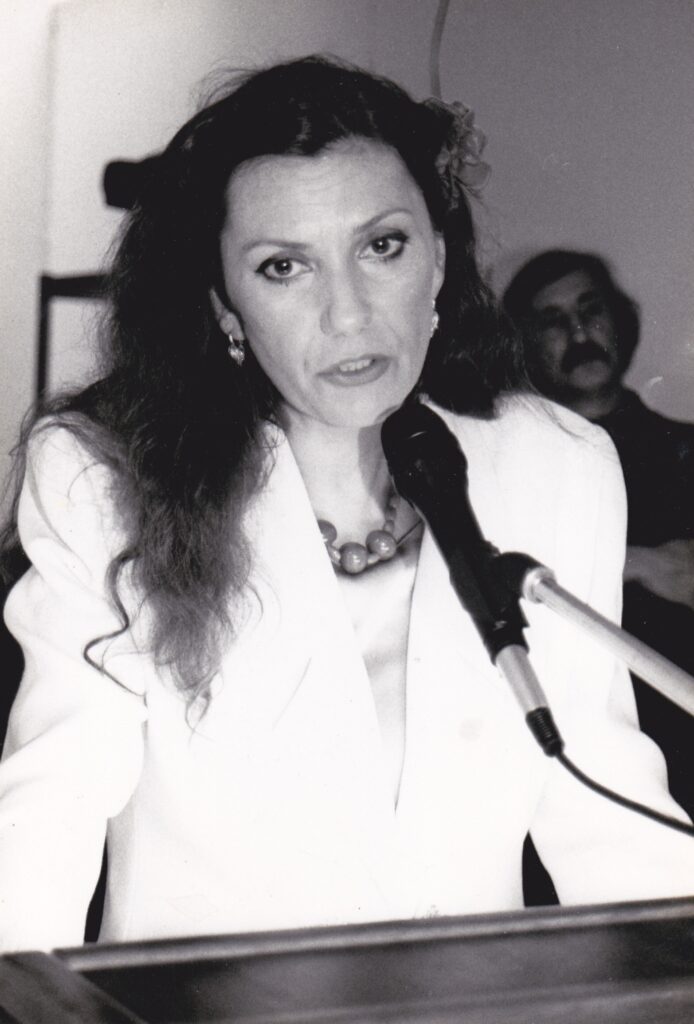
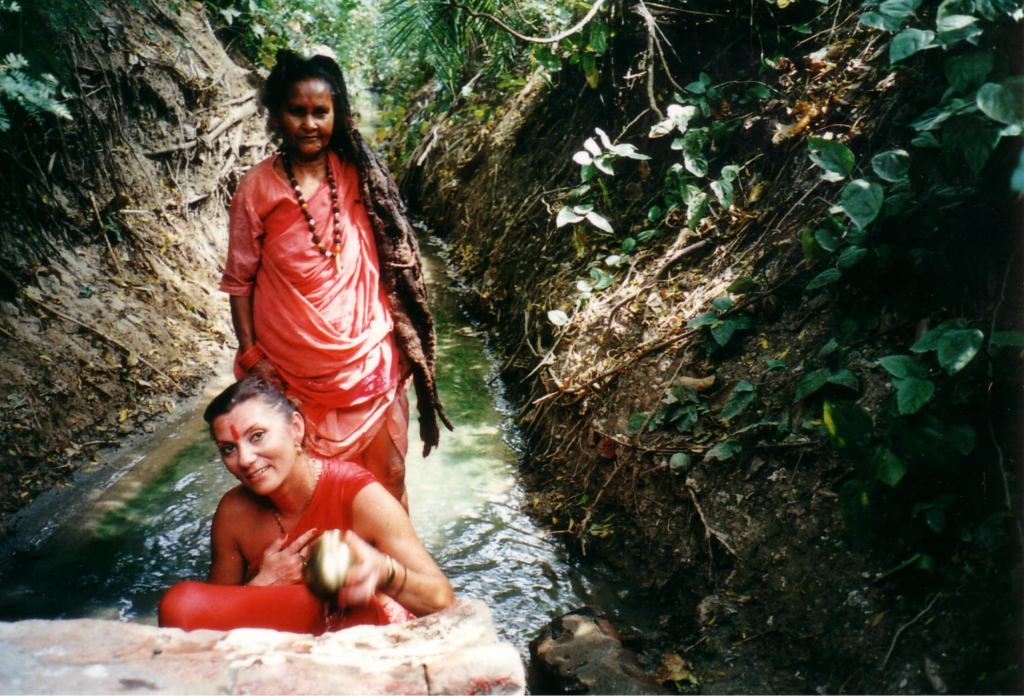
Dr. Andrea Loseries is a scholar, professor, and yogic practitioner. You will hear about Andrea’s path from being a 19-year-old student in Paris, to journeying to the Himalayas to study with yogic masters, including her teacher the 16th Karmapa, to becoming one of the few Western women to live and practice at Indian cremation grounds. Andrea speaks with the directness of someone who has spent decades facing what most avoid—death, darkness, and the dissolution of the boundaries between pure and impure at what she calls: the gates to liberation.
~
Time notes:
00:01:06 – Journeying to the Himalayas to study with yogic masters
00:07:38 – Taking the Karmapa as her teacher
00:12:28 – From village girl to lady in 6 months
00:16:05 – Ancient Bon religion and bone ritual objects
00:20:34 – The confiscated skull
00:23:53 – The legendary Snow Lion Expedition
00:35:56 – Guidance on choosing malas and ritual objects
00:38:51 – Learning chod practice with Chatral Rinpoche
00:49:19 – On purity and impurity at the cremation ground
00:55:02 – Being a woman at the cremation ground
01:04:30 – Using oil from burning bodies for a Mahakala lamp
This conversation originally aired on March 14, 2023
Post-listen episode with Kulavadhuta Satpurananda:
~
Rough transcript, please excuse all errors
[00:00:00] Dr. Andrea Loseries,: And I stayed also on the mud floor and under the feet of the Kali statue and oh there were rats, there were snakes, there were just everything. There was no light, there was no toilet, there was no water, nothing. It was wonderful, really.
My name is Olivia Clementine, and this is Love and Liberation Conversations that explore depth, wisdom, and relationship. Today’s guest is the scholar and yogic practitioner, Dr. Andrea Loseries. Andrea shares about her path of research and spiritual practice that stretches over more than 50 years. She tells stories about the darkness, insight, and devotion needed for genuine transformation.
[00:01:06] Olivia Clementine: In 1972 you went to the Eastern Himalayas to study with great yogic masters. And I wanted to hear if you would share about this time, like were you looking for any teachers in particular and how did you end up meeting the teachers you ended up studying with?
[00:01:25] Dr. Andrea Loseries,: first I ventured out to India in 71 and that was partly also to study some Indian art because I was enrolled at Louvre, Museum du Louvre at my special. Subject was Asian Arts at the Musée Guimet. So I was supposed to, you know, go to Ajanta, see the Sanchi stupas and all that. But it turned out differently. so I fell ill,
I, I got hepatitis on, on my way back. I had to be hospitalized in Austria. And when I came back to Paris it was closed the admission despite the, having a medical certificate and all that, it didn’t help. And then I saw these advertisements for Oriental lungs, Oriental, Oriental Language Institute in at the Sorbonne where they offered also Tibetan, and I already had from hearsay contact with the Karmapa, my guru Right.
So I decided that I cannot expect at the age of 19 that the Karmapa now, you know, a father figure will learn English, so it’s better that I learn Tibetan and because I thought it’s absolutely a necessity to be able to communicate with him. So I enrolled in Tibetan studies, but I had to complete my studies in Paris. So after that academic year only, I had the chance to go back to India and there in Paris before going to India. Shortly before that, Kalu Rinpoche came and gave refuge and. Chenrizig initiation and so on. And that was my actual, getting in touch physically with this Tibetan culture.
And, but then I was quite convinced that my guru, you know, Kalu Rinpoche was of course one of my most important teachers, but my root guru is only the Karmapa. So then I sought him out in, Sikkim. That was also not easy because the first time I went, he was not there because that was the time when the King of Bhutan has passed away.
And he was there for the funeral. He was away for I think more than a month. He was in Bhutan. And in those days it was not open for foreigners, so I had to come back another time. It was all really complicated. In those days. It was still a, a separate kingdom, right? It was not yet integrated in, in the Indian continent.
So anyway, that’s how it was. It was very clear from the very outset, and it’s so classical that I don’t really like to talk about it because it’s like a fairy tale, you know, like what you read in novels. When I came, then the Karmapa was sitting there and all his glory saying, oh, I’ve waited for you like that, when I actually met him physically, I had so many visions and dreams about him, so I was quite, you know, was not a big surprise to be in his actual presence. And I was with colleagues from the university, from Paris. And we were all there in this audience hall.
And, and he spoke and they were all starting also with me, Tibetan language. We were at the same level. then he spoke and then, then he pointed at me and he said, and you translate. And , I really don’t know how, but I have understood what he said. So that was my introduction also to, you know, To have to serve as a translator as well.
and then I went to Sikkim as often as possible. I always had an application for a Visa running. It took six months and with permission of first foreign ministry, then the Ministry of Internal Affairs. And meanwhile, I had shifted from Paris to – in India to continue my Tibetan studies there and be closer to Sikkim and also to Darjeeling where Kalu Rinpoche was teaching.
Because Karmapa himself, he did not really teach right formally. And so we were sent to other teachers. So he sent most of his students, he sent to Kalu Rinpoche to, to, to study. So I was also there in this very intimate circle of very few people. I mean, which we were just a handful. there were of course no good translators at that time.
So we struggled and did our ngondro preliminaries and you know, taught the basics but we learned that at the feet of the guru, right? And very simple circumstances in that small village, in this very tiny monastery at that time. Now it’s bigger and everything. No. I wondered, when I see now all these teachings you can buy, you can look that up in the internet.
Everything is there in the internet. You can buy the books and everything is there, but it does not have the same flare. for me, this was a very precious time. I’m still in contact with some of my fellow vajra sisters and brothers of that particular period.
[00:07:38] Olivia Clementine: So it sounded like before you met the Karmapa in person, you knew about him and you, and you had already taken him as your root teacher. Is that right? From what you shared?
[00:07:47] Dr. Andrea Loseries,: Yes, yes, yes, yes.
[00:07:48] Olivia Clementine: How did you, if you’re willing to share, How was it that you came in contact with him and decided he was your teacher prior to meeting him?
[00:07:58] Dr. Andrea Loseries,: Well I saw a picture of him, I heard about him. I touched something, which he has touched. And somehow I was only 19, but I knew in my heart that’s what I was looking for in my life. So there was never any doubt. And the karmapa himself, also, he told me that I am always near him in the past, in the present and in the future. So it’s like that.
[00:08:27] Olivia Clementine: Mm-hmm. .
And so during this time, 1971, and then this period after, it sounds like you were between studying and practicing and studying language and practicing, were those the main two parts of your life during that?
[00:08:45] Dr. Andrea Loseries,: Yeah, yeah, yeah, yeah. First I studied, I studied and I spent as much time as possible there in, in the Hills Darjeeling. But at the same time I did my studies, I always wanted to combine it in studies and it was very important for me later on, I realized when I did then my PhD in in Vienna, it gave me this important distance, right?
Because you can be carried away by your devotion and also a certain amount of naivety, you know, dealing with Tibetan culture and all its aspects. And to study the history and to read the text and all that. That was very essential that I don’t take everything for granted what the lama teach when I then started to translate for the Lama, no.
So I had a certain distance, which was also important. At the same time, I was unshaken in my devotion. But it was a devotion based on also proper insight and research from my part
I never regretted it to have, gone into academic studies. I thought it was very important, although it, it’s not that you gain much bread with the, with Tibetan and Buddhist studies, but that’s what I wanted, you know, and that was a generation at the time where one did not look at all regarding income making money, and that did not interest me anyway.
Nowadays the times are very different. They’re very much, unfortunately, very much on the hunting. After the -, I belong to this hippie generation where we, we did not believe in possessions at all, you know? When the Karmapa took me along in his first, on his first world tour, that then changed because that was a completely different world I came into.
It was very unusual. It’s still for me even after all this many years not quite clear that his holiness in his omniscience just said to me, that is a funny encounter. Actually, I’ve never spoken about that. It’s once I come into his And he was having, I had to laugh immediately because he was wearing headphones and he looked so funny, but they were not headphones. He said, oh the King of Bhutan gave it to me. It’s for protecting my ears because I’m going on an airplane, I’m going to America. And the king gave it to me for, to, I don’t know, protection of the ears.
So anyway, it was very funny. And then suddenly he said you know, many languages and I wanted you come along. And then he immediately called one of the monks and he said, your her name must be on the list. I could not quite realize what was happening, you know? and then indeed, you know, I was six months, in North America and in Europe before returning to India. And that was for me, the most important time of my life.
[00:12:28] Olivia Clementine: Were there particular, like other particular details of that time, of those six months that stay with you when you reflect?
[00:12:37] Dr. Andrea Loseries,: I came from – where I stayed in the very, in the, in the room, in the room in the shack with no electricity, no water, no toilet, nothing.
And then I come into this environment of the Karmapa and started with the fancy restaurant somewhere in Manhattan. And then we always had this V V I P reception. I still keep this text from the luggage. V V I P, part of V were, and everywhere there was champagne receptions, which of course I could take, but not the monks.
And we met all these important people everywhere, the mayors and presidents and whatnot, you know. So it was it was a completely different level. And the Karmapa was also quite strict regarding my appearance. So I had to be always very elegant and mostly he wanted to help me in Tibetan dress to show the culture also.
I, I would say that, . It sounds funny, but I’ve sort of started being a rather a village girl, you know, starting there in the Himalayas and I returned as a, as a lady. And this six months we experienced to be like six years. And this constant presence of the Karmapa was of course overshadowing, everything.
he was like the sun to be always there with him was, was absolutely extraordinary. But it was also very exhausting. It was very exhausting because we had all these hat ceremonies and with these initiations and this and that, and always something going on.
There was never any time to meditate. No. . when I then returned to, India and also to Kolkata with the Karmapa , the Monks wanted me to go to Nepal for this Rinchen Terzod Initiation, which is another, I don’t know, two months or what. No, but I had completely enough, always these crowds of people and always I, and I said, no, no, no.
then I bid farewell to the Karmapa and said, I want to go to the cremation ground because I need to meditate. That was too much for me. All these blessings, you know, I had no time to digest. And then Karmapa said, that’s all right. You will meet their disciples of my, from previous lives. but if you go there, you have to go there in my name and challenge the saddhus there.
so I had no idea. What does he mean with that? No. Kamtrul Rinpoche said, well, you have to challenge. You have to challenge. So anyway, I was not given any more explanations regarding that. I had to find it out on my own and that’s what I did, you know, and some of the monks, they said, how come you did miss this important initiation and you should have been there. This is part of the transmission, but I didn’t feel like it till now. I’m not really keen on this big assemblies. I had had enough of that .
[00:16:05] Olivia Clementine: I wanted to ask you just kind of going into some of your research specifically in your Tibetan Mahayana Tantra book, you speak about the two kinds of Bon and the fruition Bon that came from Iran to Tibet, also known as the Ancient Kingdom of Zangzung which had its own language and culture and was not part of Tibet until the eighth century.
[00:16:26] Dr. Andrea Loseries,: Right. This is part of the Bon studies. I mean, we speak of, and I have been quite associated with Bonpo masters like Tenzin Namtak and Tenzin Wangyal and he has a settlement in the us and he’s promoting Bon religion, if you call it a religion and Bon studies.
It is well researched. It was not, I mean, there was. In the ancient times in Tibet, before they came out into exile, they did not have much contact and it was not well known. It was overpowering the Buddhist culture in Tibet. But when they came out particularly thanks to the kindness of His Holiness the Dalai lama, he accepted the Bon, even the fifth order of Tibetan Buddhism, which is extraordinary.
And if one reads the history, the, from the Bon side, the history, and the Tibetan the, the Tibetan historians often distorted very much the history for the benefit of the Buddhist. So what we read by Tibetan historians, Buddhist historians, is not always very accurate. And when you then hear the Bonpo historian speaking, that gives a different picture, right?
Starting from the very beginning. And also it is very much underplayed the role of the Bon ministers had him at the time of Padmasambhava and so on. No. when one studies then this we always call the Actual Bon or the high Bon right? That is very much is that it has all the characteristics of an en enlightened teaching like the Buddha’s teaching. And you may say Bon Historians then matched their, history or their legends with the Buddhist and so on.
So whatever, you know, but it is certainly the Bon did have great influence on Tibetan Buddhist culture as well. so it should not be neglected.
[00:18:36] Olivia Clementine: in 1981, you received your doctorate, if this is correct originally focused on bone carving, which later widened include skulls and relics and iconography. Is that correct?
[00:18:48] Dr. Andrea Loseries,: Yes. More or less. Yeah. Well
[00:18:51] Olivia Clementine: Well, I thought we could start, if you are willing to share the origin story of Bone ornaments as garments of, of joyous and wrathful dieties
[00:18:58] Dr. Andrea Loseries,: of the bones, the bones
[00:19:00] Olivia Clementine: in connection with the manifestation of Chakrasamvara.
[00:19:02] Dr. Andrea Loseries,: We find that in all Buddhist tantras, it’s u usually always the same when you vanquish an enemy, when you’re victorious over an enemy, you take over his trophies, right? And that’s what I mean. It’s very much a tribal custom. there are a lot of tribal elements in the tantras anyway.
He, he took up the ornaments, including the tigers skin The weapons and all that from his enemies. One which he had slaughtered, isn’t it? That’s how it’s written in the, story, in the legend, which is always in the beginning of a tantra It’s mythological, of course.
[00:19:47] Olivia Clementine: Mm-hmm.
Well, you, you wrote also in the, the same book of yours, Tibetan Maha Yoga Tantra. You wrote “skull and bones are animistic, live endowed with power. A good yogi of Maha Tantra will use such objects of care and in accordance with his inner power.” And you, you mentioned the story with Namgyal Ronge. That he gave you a skull in 1987 on what you noted as a, a legendary snow lion expedition. And which l was later taken from you in which you say hindered your worldly and spiritual development. Can you say more on this, both how the skull impacted your life and how that is possible? The, the influence from the skull.
[00:20:34] Dr. Andrea Loseries,: Well, it was a very special skull. It was absolute nonsense. Really? It was bad. It was a one, one piece. No, one part. One, one. The we call it, it was a very special. skull, which he, he found in the market and he gave it to me. And I used it during the whole expedition. I always used it as a ritual instrument and whatnot.
And then when we came back to Nepal, I, we had to walk because of the landslide. he was having a lot of artifacts, which he had bought in Tibet and which he had to take care of. so he sent me off and gave me some of his treasures to carry over the border. and I had of course, as usually it was just one bag I had in that bag.
I always had this skull, you know. then when I crossed the border, they searched the bag. They didn’t find something else, which I had hidden in my clothes but I did not even think of it. They found a skull and they confiscated it those bastards, really, and the problem is, I said I, it was bought in Nepal.
They’re bringing it back to Nepal. But what I should have done in those days was that when you entered Nepal over land, then you had to make a list of all the things you have and then you can take these things out again, you know, which, I don’t know, I did not think about it, So they confiscated my skull.
It was very bad. Very bad. And it did affect, yes, it had a bad effect in many ways. Yeah. In my personal life and. it was an obstacle big, a big obstacle. It took me quite some time to get over it, and I attributed to the loss of that skull.
[00:22:43] Olivia Clementine: Was, was there anything you did when you realized that was what was creating obstacles for you where there’s certain practices or certain things you did?
[00:22:52] Dr. Andrea Loseries,: You do what you can. But the, the fact is that, that you have obstacles, you know, you have to overcome them and you struggle. So, in general, one should be, you know, with one ritual objects, one should be very careful. And as I have pointed out, and for instance, you don’t let other people touch your ritual objects. Even your mala, you know, or your, ornaments, whatever you wear, you know? Mm-hmm. , which are important.
Spiritual meaning to you or something. You don’t, your one one must be careful. And when I see these ignorant people in the market, you know beating a drum, blowing in the trumpet I was , I’m flabbergasted, you know, because they really don’t know what, damage that may do, you know?
[00:23:42] Olivia Clementine: Before we move on, because you mentioned that this expedition is legendary, the snow lion expedition. Will you say anything more about it? Like what about that particular expedition made it legendary?
[00:23:53] Dr. Andrea Loseries,: Well, actually I have written a book about it, but it’s, it’s not published.
Ah,
I’m now working on the last academic book, which I will book publication, which I will bring out and then I will devote myself to this sort of literary output now of my, where I speak about such things as this Snowlion Expedition, which I called it’s in German, so I would have to rewrite it.
It is between Dream and reality or something like that. It is, was this whole expedition was very much between, we were very much in the dream world. You know, we were acting only of what we dreamed. We were guided by our visions and dreams and at the same time doing an academic study.
I did a whole statistic, which was quite valuable later on, which I could complete in later years the aim of this expedition was on the basis of a text, which was written around the turn of the 19th to 20th century about all the temples and monasteries in, in central Tibet, what we call the -.
This is the central mountain population. so our aim was to look for these places and search for them, and particularly find out what of the precious objects mentioned in this text are still there. Counting in each places we went to the monks and the nuns and those who were in retreat or not, and also what sort of sacred objects were still there or they’re brought back.
So, later on I did many more visits to Tibet. I always corrected the numbers and made new entries. So that was quite useful. Particularly then for a later study, which I did on the psychic sports in Tibet. That was very useful to have these early numbers, but not only on on the monasteries, but also on the no the cattle breeders.
How much cattle they still had and so on. That was very interesting.
[00:26:23] Olivia Clementine: You’ve mentioned that before the 11th century, before the pre monastic institutions really expanded that Tantric rituals were much more simplified.
And I’m, I’m wondering if you would give some examples of that.
[00:26:36] Dr. Andrea Loseries,: Well, I always thought that it happened in, in, in this period with the institutional of, of Buddhism. Tibet, meaning in the 11th century or 12th century, where all these big monasteries were built.
But in later research, which is not yet in the book, but in some other, in my omnibus, it is written I think in -, yes, I, I found out that it already happened in India at the great monastic centers of Nalanda and Kamalashila. That was the time when the Tantras, the Tantric scriptures where become part of the syllabus in the monastic universities.
there several abbotts -. I started mainly on the example of Chakrasamvara and there were mostly the – from Vikramashila involved to what I call execute the polarization of the, the Tantras . This term is, goes back to a person who for the sake of his daughter or niece, this certain has rewritten Shakespeare. Because Shakespeare in many of his plays was using quite obscene language. So he did not want to embarrass his spoil his virgin daughter whatever.
She was her niece. So, so that’s what he did. And he cut out all these passages and that’s what they did in Vikramashila as well, with the Tantras with the Chakramsavara tantras, for instance. There are two main things. One is that they cut out put into the outer margin of the mandala only the names of Brahmanical deities right.
So they were there because in the, you know, when these root first were orally, of course only transmitted, there was not this difference between Buddhist and Hindu tantras. Not at all. You know. So we do have a lot of dieties within the man, but names like Ishwara and so on, they were eliminated, you know?
And second, what also happened in Vikramashila is that they cut down the role of the woman in the Tantras, right? So they also sort of, Made it less important as it is supposed to be. And that continued of course in Tibet starting with Atisa, who was, as we also revolted in, when he came to West Tibet to see this misuse of rituals and misunderstanding of Tantric Rituals They were a little bit out of their limits in their practices, having not proper guidance in those days due to – dharma was also the Buddhist historians say has destroyed Buddhist in Central Tibet. but still the Yogic lineages, the Ngakpa, the Yogic traditions had survived very well in Tibet even when the monasteries were all destroyed or lockdown.
So the Tantric tradition was very much still alive. But when they then built this big monastery and we speak of the big monastery of – and then that was in 1100 and I have to look it up. I don’t know exactly a short 50 years later already – was built and so on. So there were this big monastery built with many manys adepts, right?
Many adepts and then they slowly changed, you know? And even now, I, I honestly speaking, even in exile now in India, when I see this temples and how opulent again they are with gold and silver and precious and semi-precious stones and whatnot, you know, I really wonder that they have not learned anything from history somehow.
No. It’s because these things can be destroyed. But anyway, I’m not really fond of all this pomp Right. So that’s why they also, then they, because it’s more precious, it’s more important than they used ivory instead of human bones. Or they made this silver or, or silver inlays for the skulls.
That’s not at all in the tradition, right? Mm-hmm. . But you see that, you see that, at one point, of course we can understand their devotion to offer only the best and whatnot, but somehow it’s not the same. Or also the trumpets, you know, it might be a human femar inside, but the outer bodies made out of some metal or silver and so on.
And we don’t need that. No.
[00:32:10] Olivia Clementine: Do you think we lose some of the power of the intention of it supporting cultivating pure,
vision?
[00:32:18] Dr. Andrea Loseries,: Well, certainly because these are, these are all new things and you get distracted by that, you know, by the splendor somehow, you know? My opinion, It’s so Impressive to go to this rich monastery and the, their whole equipment and along this brocade and silk hangings. Ah, amazing. actually it is, all this is not necessary, but this is their way also to preserve, they say it’s their culture and so on, which has to be preserved in a way.
It’s true. On the other hand, I remember the Dalai Lama saying I was for a conference in Nako. Nako that is in Kinnaur in Himachal Pradesh, where there is a temple, which was built in the 11th century by Rinchen Sangpo and Austrians and UNESCO project for 10 years were conserving this old temple complex. And when that work was finished, there was a conference and the Dalai Lama came and gave a Chakramsavara initiation and whatnot.
And all these village people came from far away. And it was wonderful actually to see all these different Himalayan people there. And then he graced also our small conference with his presence. And then when he, he sat down on the chair, not on the throne, which was prepared for him. And then he said, look, all these.
paraphernalia, all this, I written down every word. So I remember very well what he said. All this paraphernalia, all this equipment, all this, and that actually, you know, it’s useless. It is your job. So he sort of pointed out to us experts to preserve all that. And it’s good to put it in a museum, right? That’s good.
But this is not actually what what is our most important legacy? Is it the only thing? This is all, you know, this is all just, you know, stuff, right? Stuff. But what the, what we really can contribute to the world. He said we Tibetan Buddhists. What we really have preserved well, and for this, the only valuable thing which we can, you know, offer to the modern world is our understanding of the interdependence the interdependent origination of all dharmas of all phenomena, right?
He said this understanding, this insight this wisdom we have preserved well, and that is our contribution to the modern world with all its sciences technologies. So I found it very interesting, you know?
[00:35:19] Olivia Clementine: Yeah. very grounded wisdom for these times.
[00:35:24] Dr. Andrea Loseries,: Yeah, absolutely.
Oh, of course. That is already another, that was 10 years ago. Anyway,
[00:35:32] Olivia Clementine: well just to speak about one of the ornaments malas are one of the more common ritual ornaments that people are connected with. And you mentioned earlier this kind of you know, people showing their malas and that not being the, the appropriate thing or having other people touch them.
And can you speak to how the material and the use can support different activities? You know, if we’re trying to magnetize or whatever the particular activity we’re trying to encourage
[00:35:56] Dr. Andrea Loseries,: The so-called Bodhi seed mala, which is the safest you may say to use. And of course you can find them in India easily. And they also not expensive. So Bodhi seed is safe thing to use always, right? But then you can go fancy if you want. And particularly the Chinese in Hong Kong and so on, they produce.
And in Singapore, I have heard they produce very fancy malas out of jade. You know, jade, which would be good for doing green tara, for instance. It goes with the color or a crystal. A crystal mala is good for Avalokiteshvara practice Coral, I think it’s good for Hiyagriva who is wrathful and red in color.
And of course you may also have a, nowadays they’re very difficult to find a genuine bone mala, you know, human bone mala. It’s very difficult to find nowadays because, there are many fake, fake in the sense that they’re not genuine human bones, but they’re buffalo bones and all sort of camel bones.
Camel bones is white in, in lighter than buffalo. Buffalo bone that gets, or donkey bones or whatnot. They use, it gets rather yellowish. . I still have my human bone earrings I write about in the book. I still have them, but keep them very safely and only use them at rare occasions because they have now discolored and I don’t want to lose them.
[00:37:39] Olivia Clementine: It’s interesting what you said about the bone malas They were traditionally collected from 108 different people so that you wouldn’t have too much of one kind of karma necessarily.
[00:37:53] Dr. Andrea Loseries,: Well, I mean, yeah, that is, that’s right. It’s not easy. No, it’s not easy. No. so you can make them out of skulls, but what I observe when I did my field study, they, they cut it out of the, of the femurs mostly. Whether it is animal now or human. So that’s a different, different technique. Of course old malas are interesting because they have been used no for many, many years, malas don’t have this, danger. There’s not so much danger in using a mala than with other things. You know, most careful I would be with the, bone trumpet.
[00:38:37] Olivia Clementine: You spent 12 years learning chod with Chatral Rinpoche, and and he also instructed you on the proper way to handle instruments and to begin with, how did you end up learning with him.
[00:38:51] Dr. Andrea Loseries,: Well, first when I came I received initiation from Dudjom Rinpoche in a very small circle.
Small circle means there were not more than five people, including him. So that is the, actually the best you need to have five people to complete the mandala huh? And then he sent me to Chatral Rinpoche to learn. So Chatral Rinpoche first, he sent me to a small nunnery in -, nearby between, -, there it was.
And there with this nuns, you know, there, I learned to handle the bell and the drum at the same time. It needs practice.
[00:39:36] Olivia Clementine: What were some, some instruction that he gave you?
[00:39:40] Dr. Andrea Loseries,: Chatral Rinpoche was also a very impulsive extraordinary yogi teacher anyway, when ond did something wrong, then he usually burst out in a temper, whether he gave me these instructions or not, I cannot him say, you know, but he made very sure that I learned it by heart. And then I had to, you know, he examined me whether I know it. He did not really emphasize that I sing it in a very melodious voice because I am a terrible singer and have no musical training at all.
I said, the only thing what I have instrument, I can play the bone trumpet. So that was not the point. And also when I asked him regarding the dance, he said, you do whatever you want. You go Right. You know, so no ritual steps or anything he told me and then he just made me do it. You know, he took me by his hand and.
to the jungle there, there was jungle there, it was also in the evening. And he said, you never use any torch or candle or light source. No. It must be absolutely in the dark. and then you do your thing
and never get up. No, never run away. And there’s a certain posture and you need a, you know, a belt or something. And all this actually it is in, in the Khandro Kejang that particular practice, which I mostly do. There is also detailed instruction, how, how to work, how to do, and. in the commentary.
[00:41:27] Olivia Clementine: You were saying earlier that there’s something very particular, we have to be careful with the actual bone trumpet.
[00:41:34] Dr. Andrea Loseries,: before you begin, you have to say Vajrasattva mantra, and then usually one puts also some water or some other liquid inside for the sound. Then you beat it on your palm and, there are certain melodies, you know, there’s invocation and then there’s offering, and then also to send them away so that you, you call the spirits.
That’s why one should be careful, you know, when you blow the horn, they come, you know, so if you’re not able to handle that, then you, then there are problems. Mm-hmm. , it’s a tantric practice after all. Now when I see this beautiful you see that also on YouTube, wherever, I don’t know, in the west or also in India or wherever in the world.
Large assembly of nuns and monks and yogis and yoginis they performed the chod in one voice. And beautiful old, you know, in harmony. You know that is great, of course, but this is not the way I was taught by Chatral Rinpoche because he said, you just, you know, you go, wild. Because if you are not in a temple Hall, you know, with so many others, right?
And maybe an audience even, but if you’re just alone in the jungle around the cremation ground at night, it’s different. Particularly when you have, you know, no light, no, you have to learn to see in the dark. And then of course as you invite, you are not inviting only spirits. You invite all sorts of creatures as well.
Yeah. So you have to deal with that. Snakes and scorpions, they come out at night. And that’s another thing what he told me, that is that you should not protect yourself. You know, when you have protection cords or amulets, you should take it off. You should go naked. The best.
[00:43:46] Olivia Clementine: Did you have any experiences of scorpions or snakes and, you know, in the midst of your practice, what, what did you do?
[00:43:53] Dr. Andrea Loseries,: Oh, yes, of course. Yeah, yeah, yeah.
It happens. Yeah.
[00:43:59] Olivia Clementine: And so you just kept practicing?
[00:44:01] Dr. Andrea Loseries,: Well, once you have this thought of that, you may not die, that it’s already over. No. Right, right. But you have to remain. Absolutely. That’s, that’s the only way to remain in that state. In the nature of your mind. That’s the only way you can deal with it. No. Because if there’s only a thought, you know, then it’s, then it’s gone.
It’s not that, it’s always like that. I was once doing a, a very specific practice, dzogchen practice where one has to stand up and then has to fall on one’s back. And I did that it was always on the cremation ground, I did that for some time.
It was going very well. , but then suddenly I saw right next to me and, you know, lying on the back like that, you know, gazing at the sky, a very big, very, very, very poisonous kind of snake, you know? And then I packed up . I didn’t continue right. It would’ve been too risky to continue that particular practice because it was combined with sound and this and that.
I don’t know. And anyway, I, I, anyway, I gave up. when I asked about that one of my teachers then he said, well, you probably, you have not done at a ritual for asking permission to use that ground. So that is also an important thing, you know, that you don’t irritate all these spirits.
So there, but on the other hand, one, one gets used to that one, just has to be careful.
[00:45:48] Olivia Clementine: Being somebody that has spent so much time as a scholar and as a practitioner in ritual, in your daily life now, are you still doing, you know, complex pujas or do you, are you somebody who
does the essence of practice now, or it sounds like you’re less interested in elaboration and yet you like to do things properly. I’m curious where, where that is now in your life.
[00:46:10] Dr. Andrea Loseries,: With that program, with the American that we had you know, our meditation sessions, there were, there was a master taught Shamatha and Vipasana, and I was interested in that because I was never taught in the Theravada tradition, which I prefer the term.
The shamatha and vipasana I only had it from our Mahamudra context right so I was interested in that and, and then there was a zen master coming to teach a zen. And I have done a lot of zen meditations, so I like that, right? And so we had these regular meditations there.
But usually for myself, I keep it very simple. I hardly use any texts except when there is the need. I hardly do formal practice at all. I have my little yoga thing, and I’m very much, and my pranayam , which I do. That is my main thing. And then I try to keep my awareness as much as possible in any situation.
Right? Sometimes I get carried away and when I go to the cremation ground, of course there I have obligations, right? And there is a need because after all, when at the cremation ground, there are all these dead spirits and so on, and it is very meaningful for them, you know, to, to be in, in the state, in a meditative state because that’s what they, what helps them.
They feed on samadhi. They feed on your samadhi, so you better do it. You know, it’s a good, it’s the best offering and you can give to them. And that is the only thing which really helps. Not crying, not this, not screaming, that’s my reason also for going there.
I get they are more inspiration than from a temple . Except places like Bodhgaya, of course and such you know, sacred sites also in Tibet or, so that’s different. Otherwise, my place of meditation is always out in the open. I don’t need a temple. Mm-hmm. at all. Even in Bodhgaya, I sit under the tree.
Not on the actual Bodhi tree because there are many people, but there’s another Bodhi tree under that one. I sit.
It’s just my style, you know, I’m like that, you know, and I was eight years in convent school when I was a girl, and so I’m a little bit allergic to too much.
[00:48:57] Olivia Clementine: When we see temples and all these shrines, there’s such a focus on order and cleanliness and a certain idea of what purity is, and the charnel ground practice and being in a charnel ground seems like the antithesis, it seems so impure when, I’m curious if you could speak from the tantric perspective of purity and how the charnel ground supports that
[00:49:19] Dr. Andrea Loseries,: there is no such a thing as impurity and purity at the cremation ground, which I always call the gates to liberation. this differences are obsolete, right? We mix with the doms. The doms are the one who burn the bodies, and they are outcasts. Of course. They’re not in low castes they’re outcasts.
People would not even sit and drink with them, you know, but we do, right? We mix with them. We mix with them, and one learns to, appreciate what we call also the one taste, There’s this story about that Sadhu Baba there in my cremation ground, he passed away. So now he was a very learned person actually from a region he was a braman, he spoke very well English, his name was Shiva Baba. And he had decided at a young age that he does not want to, you know, to take over this – the property of his ancestors.
But he wanted to go live on the cremation ground, and he did that all his life, you know, came as a young man. So, I enjoyed of course, having this nice conversations with him and cuz he was very learned and educated was a pleasure. But of course he was also a bit mad, right? He had long, dreadlocks and looked great.
He had a tall figure and was good looking. Old already. He was already in his seventies or something when I met him. And then he had this young apprentice, you say we called him the mad one, the Bagla. He was sort of squinted eye and so that was his guru. So he wanted to, he told me that himself, the bagla, he told me that story.
He said he wanted to test his guru, so he took a skull cup and collected whatever he could find. So he collected to, he said dog sh*t then sweets, fruits, whatever he could find. And then from the cremation ground, he, he cut the breast of a corpse of female corpse and I think he urinated in it or something.
he put flowers and made it look nice, and then he offered it to his guru, and Shiva Baba He said, ha ha ha ha, let me relish that. And he finished it all, you know, so that’s just an example how you go beyond your conventional limits of you know, what is pure and what is impure.
That’s the way it is at the cremation ground.
[00:52:21] Olivia Clementine: were you sleeping at the cremation ground or just visiting for practice ?
[00:52:25] Dr. Andrea Loseries,: Well, at beginning there was only a small simple mud hut.
And where the Sadhu Ma and Sadhu Baba, they stayed together. And I stayed also on the floor, on the mud floor and under the feet of the Kali statue and oh There were rats, there were snakes, there were just everything. There was no light, there was no toilet, there was no water, nothing. It was wonderful, really.
But then later on Sadhu Baba, he passed away. Then Sadhu Ma was alone. And once I came and that little hut was completely carried away by a flood there is a river, nearby by the flood, she had nothing. Nothing. Absolutely nothing. so, and then I gave some funds, emitted funds to build the simple house out of brick and a little bit higher up, so it does not get flooded anymore.
So there she was much better off. we built a, well also that she did not have to draw the water from a neighbor Ashram from the river. And then she made it even bigger, but that was unfinished. And then, then she also passed away, and then I continued. The roof was a bit bamboo and with plastic and, you know, really had some tins that was in a very bad shape, very bad shape. so over the internet, I asked my friends and I posted also pictures that it needs repair and I was able to collect some money and with that I could repair and then my own funds also and nowadays rather comfortable.
And then when I shifted, when I gave up my house in where I used to stay for many years at the university in my household affairs to the ashram. But then for that I needed to install electricity. There was no electricity. So now we have electricity. Then I built a toilet, also one outer toilet and one a private toilet for myself with proper septic tank.
[00:54:55] Olivia Clementine: What was it like being a woman living at the cremation ground and were there many women or were you one of the few?
[00:55:02] Dr. Andrea Loseries,: Yeah, I wanted to speak about that. I’ve done some inquiries and research on that. They are not many women there. Some of them they are.
I mean, that’s how I came because I had befriended this Sadhu Baba and this Sadhu Ma so in those days, they were living as a couple okay. Till he passed away and then she was living alone and She did not allow any man to come inside the house. A house, I mean, in our little ashram I stayed with her off and on In those days I had the luxury that I could go and sit under the tree while she was doing all this, you know, cleaning and cooking and all that. So I was free of that. And I could just, I had to come because she obliged me to, to, to, to interrupt to come for lunch. But then I usually went back and I had my eight hours.
So that was a good arrangement. Then at one point when I came, there was another Sadhu woman not living with her, so I was wondering. That woman I had to take some measurements. For instance, she bought a live chicken to kill it and I immediately sent it away, you know, and then she had another practice to cut herself. And do blood offering, which is absolutely against our, you know, traditions. Absolutely not done at all. and then I inquired and it happened that she was a destitute widow and according to the Indian custom, she was thrown out of the house of her in-laws, and there she had no other refuge. Now the same story is about the Sadhu ma.
When she told me her life story it’s, well, less similar. That means she got her fa her father was a rather, you know, not rich, but well to do farmer. And she got married at a young age, according to the rural she must have been in her teens still. then she gave a birth to her boy, and within one year her child and her husband died.
And of course she could not go back to her family. It’s not the custom. And then she had this dream, she had this dream that there will be Sadhu coming and knock at her door begging and she should go with him. Now there was Kalu Baba and Kalu Baba had a similar dream that he should go to such and such house and take this woman with him, you see?
So that is very exceptional. But what does it say? It means that all these women. Whoever they are, whether they wear the dress of a Sadhu or -, or whether they are spiritual or not most of the time they’re there because they were destitute, you know, they have nowhere else to go. So this is rather different from the man, the Sadhus. Most of them whom I talked to, some of them had decided at a very young age not to marry and to become a sadhu, a wandering sadhu, you know, so that is a different story. But the women I find mostly they’re, they are widows, no windows have no space in Indian society. So that was my observation.
Well, now I’m a widow myself, but I have been there since the very early age. I was 20 when I came there. of course I saw that Sadhu ma living alone, she was quite strict. She had her strict rules. and she did not allow those who want to drink and smoke ganja the whole day.
She did not allow. Right. So that was rather strict now, and it was a sort of a we may call it the female ashram, it was just her and me. And sometimes there were also women, but they didn’t stay, they went away again no, like the one I told about, no, she didn’t stay long. Then there was another one another Sadhu ma she later on moved to the temple complex and got this small setting there where she stayed and then served another
Sadhu and she passed away also. Then we have, of course the female -. That’s a different story. – are, we cannot call them pure tantrics. Some of them are mostly -, and of course in the – Communities they are, they’re married, so that’s about it.
And I had in the beginning, after I was alone a hard to change the atmosphere. it took it couple of years for me to get the respect, which I have now, because there were all these young men always wanting money to drink this local liquor and smoking ganja the whole day. And I didn’t like that, you know, from the beginning and so on.
This, no, in the morning and nonstop. So I, I often had to, – means with the broom or something, you know, to throw them out. Now it’s much better. And I don’t have this problem anymore. I keep a very strict discipline there. There’s no other way. You know, they think at after the demise of the Sadhu ma it was sort of common knowledge that you can hang out there and have a feast and smoke and drink.
But what’s that? That’s not our now it’s okay. Since a couple of years, it’s good. So you see the, as a woman, it’s not so easy, but after years, and they do know me afterwards, it’s 50 years. And the young ones, they may have not even seen me in the early days, but they have always seen me there.
So they have grown up with my presence. it takes time. It’s only matter of time. But certainly what will not change in the near future is that those women you find as sort of Sadhume Sadhuma, they’re often really, they had no other choice than to embrace a spiritual life. So it’s very obvious.
[01:02:37] Olivia Clementine: So it sounds your main experience has been in this one place too. Like you weren’t wandering other cremation grounds. So when you’re doing charnel ground practice, you’re in this one place where people have known you over decades.
[01:02:50] Dr. Andrea Loseries,: I just came back yesterday because of this podcast, Usually I go every day to the cremation ground and see whether there are bodies or not even, there are no bodies.
That’s even better when there are no burning bodies because sometimes there are many people. So of course I, I challenge myself wondering, am I doing the right thing? Is it really genuine what I’m doing? No, I question myself. I question myself, but I could, this time, I could provide again without any further trouble from these doms, who burn the bodies.
Now I’m made them to deliver without any charges regularly. This oil, you know, from the burning body, the oil, which I use for my lamp. You know, my offering lamp from Mahakala. So that’s a good thing. . So I managed, I managed to have a good deal with them. They’re not usually, they were asking money for that, you know, but also they want money for a I said, I will not pay. This is, I told them also that if they sell it and they demand money for it, that is a very bad, for them, you know. It’s not auspicious and it’s a sort of bad karma.
[01:04:24] Olivia Clementine: So you’re getting the oil from these bodies to light your Mahakala lamp for practice?
[01:04:30] Dr. Andrea Loseries,: Yeah. I get more and more demands, I cannot say, but people ask me to do certain things. There was terrible suicide. I only received yesterday. I should do something about that. Then there was a healing ritual for an Indian family in Austria. Fortunately, that was successful. Now I have some other people there in Bangal.
I don’t know they are. I think there’s some ghost or something in their house. So anyway, if necessary, I have to fly to Bangalore and see myself, but if it’s too much, I can, I can’t, I cannot solve all the problems of this world, you know? It’s impossible.
[01:05:20] Olivia Clementine: I guess as we close, What’s most important to you right now with your energy?
[01:05:25] Dr. Andrea Loseries,: For me right now is, of course, when they demand they ask me to do certain things, you know, then I have to perform special prayers and rituals. So that is one thing that, of course I want to have it, that it should be of benefit for them.
And I’m not asking any money sometimes for these expensive fire rituals. I, I do ask for some for the expenses, usually, it’s the tantrics here in Bengal they charge tremendous amount of money for that sort of ritual. If you go to -, you can spend, you, they may ask you for I don’t know, $2,000, something like that.
You know, so outrageous. I’m not doing that. I’ve considered that to be not good. And then I try to remain in my natural state of mind. That’s all in the present. Yeah. I have certain projects to finish. I want to finish this last omnibus I’m half through, so I’m sitting there on my desk, can work on that.
According to my age, I take it easy and It’s not that I told you, I’m not really into formal practice unless, you know there is some demands. When I go to the cremation, I do my Mahakala puja a little bit with damaru and bell, and all that because they like that The spirits are there. You know, the spirits are there.