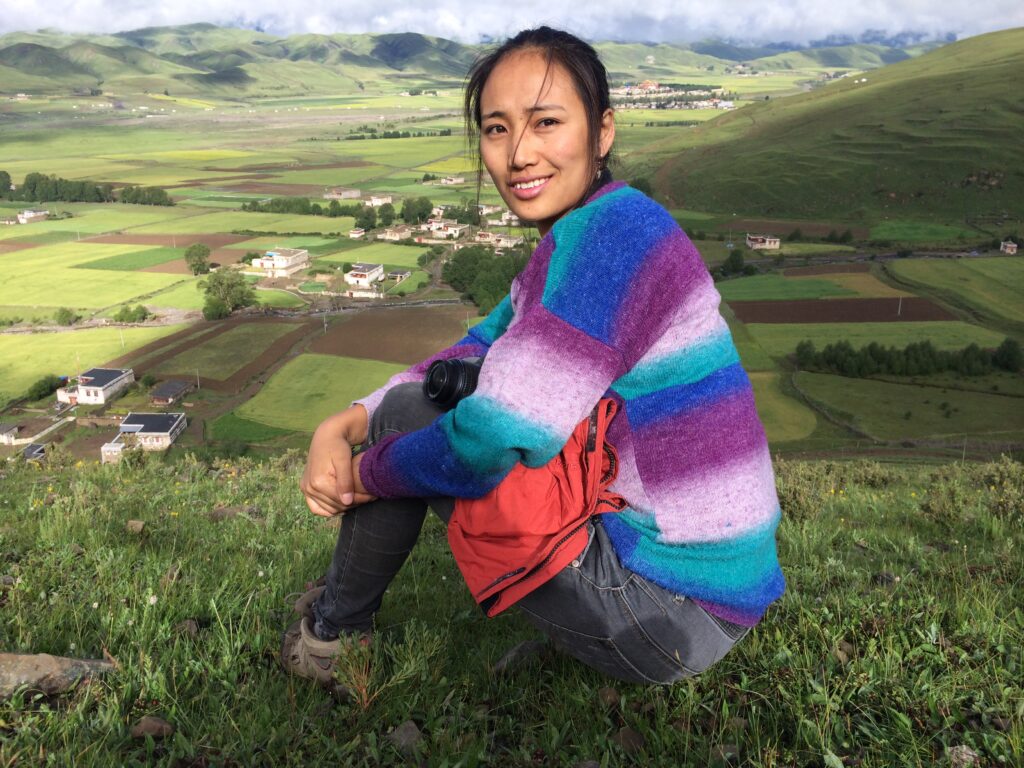
Tashi Dekyid Monet is a Tibetan scholar, writer, and translator who grew up in the Eastern Tibetan Highlands in the rhythms of nomadic and agricultural life, where time is measured by light and shadow, where songs carry cosmological wisdom and where knowing the face of the land means being woven into a web of reciprocal relationships with all four realms of beings. Through explorations of oral tradition, sacred geography, spiritual songs, and the concept of tendrel, or auspicious connection, Tashi offers insights into ways of knowing that nurture belonging, protect sacred knowledge, and recognize land itself as a teacher.
Time notes:
00:00:00 — Introduction
00:01:30 — Nomadic Highlands, Sacred Peaks
00:07:00 — Village Life as Education
00:10:00 — Light, Shadow, Flowers and Birds Tell the Time
00:16:00 — Knowing the Face of the Land
00:19:30 — When Land Extends Your Very Self
00:22:30 — Songs That Carry Cosmological Wisdom
00:26:00 — Tashi Sings
00:29:30 — The Yogi Shabkar and the Sacred Mountain
00:34:00 — A Dream Visit With the Mountain King
00:38:00 — Four Realms
00:42:30 — Consequences of Breaking Reciprocity
00:46:00 — The Secret Layer
00:50:00 — Protecting Knowledge From Extraction
00:54:00 — What Is Tendrel?
00:58:00 — Recognizing Auspicious Connections
01:02:00 — Raising Children in a Foreign Land
01:06:00 — Tashi Sings: Exquisite Abundance
01:10:30 — A Closing Prayer for Auspiciousness
~
Links:
Post-listen episode:
Drukmo Gyal: Ngakma Lifestyle, Slowing Down & Balancing the Inner Elements
https://oliviaclementine.com/drukmo-gyal-ngakma-lifestyle-slowing-down-balancing-the-inner-elements/
~
Tashi Dekyid Monet Biography:
Dr. Tashi Dekyid Monet (མོ་ངེ་བཀྲ་ཤིས་བདེ་སྐྱིད།) is a Tibetan scholar, writer, and translator whose academic and literary work explores Indigenous Land-based traditions, multispecies care, and the intersections of literature, spirituality, peoplehood, and the environment. Born and raised in Minyak Rabgang, one of the Six Mountain Ranges of eastern Tibet, she earned her BA in Tibetan Literature from Minzu University of China. She received her Ph.D. in Education from the University of Virginia (2024), where her research connects Tibetan literary and oral traditions of Land, Buddhist sacred geography, Indigenous storytelling, popular culture—art, music, literature and film—with global conversations on decolonial methodologies, critical Indigenous education, human geography, environmental humanities, and multispecies justice.
Tashi Dekyid is a postdoctoral scholar in the Modern Tibetan Studies program at Weatherhead East Asian Institute, Columbia University, where she co-leads a collaborative Indigenous-led the project on “Indigenous Knowledge and Climate Change on the Tibetan Plateau and the Himalayas.” Her publications includes “Translating the Tibetan Lifeworld: An Ontological Bridge or Erasure” (Yeshe), a co-edited trilingual anthology Hope that Burns, Friendship that Heals: An Anthology by Tibetan Women Writers, and “Rejoicing in Reciprocity” (The Brooklyn Rail), She has authored three Tibetan-language children’s books—Ten Precious Yaks, Snow Friend, and Where Are You?—and translated works by Joy Harjo, Leslie Marmon Silko, Margaret Atwood, and others into Tibetan. She co-organized the 2022 international Symposium of Tibetan Women Writers at University of Virginia.
~
Rough Transcript (please excuse all errors)
My name is Olivia Clementine, and this is Love and Liberation. Today our guest is Tashi Dekyid Monet. A Tibetan scholar, writer, and translator Tashi grew up in the Eastern Tibetan Highlands in the rhythms of nomadic and agricultural life, where time is measured by light and shadow, where songs carry cosmological wisdom and where knowing the face of the land means being woven into a web of reciprocal relationships with all four realms of beings. Through explorations of oral tradition, sacred geography, spiritual songs, and the concept of tendrel or auspicious connection Tashi offers insights into ways of knowing that nurture belonging, protect sacred knowledge and recognize land itself as a teacher.
[00:01:15] Olivia: first of all, thank you Tashi for meeting and it would be wonderful to ground our conversation in your home place, because that’s been a huge influence and focus of your research. will you speak about where you grew up and the prominent rhythms of your days and years?
[00:01:35] Tashi: First of all, i’m very happy that we are able to find a time and meet across the ocean I would love to share a bit about my home place, is part of the sixth great mountain range in Eastern Tibet, – in Tibetan.
So one of them is called, which is the great Minya, um, mountain range. And, uh, I grew up in, uh, the semi nomadic, community. that means we have both, fields to farm, where we grow Barley, potatoes and few other vegetables. And then we also have, animals to herd. So we had, horses, sheep, and parts of the family goes up to the mountains in the summer and winter, month.
We all stay together in the house, in the valley. we have different pastures, that you move through the seasons. spring, summer, fall back to the house in the winter, So I grew up in that kind of community, a very small community. The summer pasture is really high up in the mountain, and once you are on top of that, you can see all directions.
And you see many of our sacred mountains, like, – and, – have the, these are our what I call territorial sovereign. These are the rulers, protectors of our region. And they’re called, -, in Tibetan, or they’re a type of, uh, land based spirit.
nyen or lha different names, in the mountains we live in black yak wool tent, -, uh, which in our dialect called – Yeah, so I was with my family in the community until I was 11 years old and then I went to, schools , eventually I was able to go to, Central University for minority in Beijing, and 2024 I finished, my, doctoral degree in education at University of Virginia and where I did my dissertation that we are gonna talk about today.
Working through my dissertation, I was able to look back and see what I experienced and learned is a form of education. cause often we don’t see those experiences growing up in a village, in, in a community that is
full of, learning and culture and, education. These often we don’t see as a forms of education, ’cause education we think is happening only in schools and monasteries So I was, doing this dissertation project, and reflecting on what it means to be educated, how we learn, and with whom and from, you know whom.
So those kind of, questions really, enabled me to rethink, and appreciate what I went through, in our village, in our community, uh, with all the lives and the culture and the at, the ceremonies in village is a form of education. In my dissertation, I talk about, uh, literacies of land, which is a way of understanding, relating to, all, all the other lives around you, a so one example could be the seasonal change, which, is a way of, you know, understanding time. We understand these days we have clock time, calendar time, you know, for that, kind of written time or technological times. Uh, but you know, the seasonal change time is a dynamic, process and you see and experience and learn about them, not only like, cognitively, but like experientially and also embodied way.
for example, in our community, like what kind of animals and which flowers signals what time of the year is we have this flower called, uh, -, which can be translated as the calf herder flower. It comes up first in the spring, and it’s signals the start of the spring, but also at the time during which the yak calves are born.
and another bird called the – in written kind of classical Tibetan, but also we call -, which, comes in the spring. That’s also signals a time, the spring time. And, as kids, we were taught to observe what part of the, bird you see first. If you see its back, that means you have a good year in terms of, shelter, clothing.
If you see his stomach or her stomach, it signals that you have a good harvest and food production, things like that. It sounds simple and naive maybe, but it’s really train your attention to the change and the, the dynamics of the life, the actual world moving, like the earth is turning, right?
I think this is really powerful, learning process and teaching and, training our attentions and hearts to see the live process of the land. The light and shadow, is also a kind of form of time.
Of how we actually recognize the face of the, land or the valley. I’m, I’m sure other cultures do that too, but you follow the morning light sunlight coming first when it, the light hits the peak of the mountain.
very early morning. And then, then you can follow that light in our valley, there’s a river. once the light comes down to a river. the morning is done and then, in the evening you’ll follow the shadow on the other side. ‘ we are told, you know, once the shadow is on this mountain, on this valley, you go get the yaks and things like that.
it’s an example of how children, or even like adults are being observant of the change on the land. Even the stars In a single day.
[00:07:50] Olivia: I would love to go through some of the aspects of being in relationship with land through these three levels that you speak of in your work, the outer, inner and secret. I guess we can begin with the outer, and it goes back to something you were sharing a moment ago, knowing the face of the land.
and you talk about the need to know the land and the people, indivisible. And to know the essence, the face of all of these parts that people land deities, spirits. you also say that if someone feels disconnected or disoriented, they may say they don’t know these faces. so let’s begin then with knowing the face of these beings and place. What does this mean?
[00:08:32] Tashi: so I was taking that from a Tibetan way of talking about place, like knowing the face of the land we says, -, which appears a lot in Gesar epic stories. You know, Gesar epics supposed to be the longest epic, in the world. The dialogues and conversations between characters are mostly based in songs. So the songs begin with, if you don’t know the face of this land they tell whole history of the land, and then they’ll, if you don’t know the face of the deity and then they, they’ll go on finally to know if you don’t know the face of the this person, and then they will introduce themselves.
So I was, taking from that, but also it’s, used a lot in Tibetan, ways to describe someone’s knowledge of place. if someone don’t know the place or they feel really, as you say, disoriented and, out of place, and they’ll say, I don’t know, the face of this land, these people or the deities, that really means you are completely lost you are in a foreign place.
that’s where the phrase come from, knowing the face of the land. I was also drawing a lot from indigenous studies literature. Here they talk about literacies of land or land literacy. in my dissertation, in the outer chapter, the outer layer of, the life world of Tibetan land education, I talk about the ways that we.
recognize and relate to, to the land and all the beings, that part of the land. And then this is a process of, observable, empirical experiential process. I was sharing early on about the observing the seasonal change, the relationship between the plants and animals and the community.
[00:10:23] Olivia: going back to this piece of knowing the face of the land and knowing these different aspects, right?
Not necessarily even just the land, but also the deities and the animals and other beings. And will you also just talk about land and belonging, what happens when we’re tethered to the land by so many points such as these?
[00:10:42] Tashi: One thing I really came to understand is being away from my homeland the valley, the mountains I grew up in is, I feel like my myself is extended throughout the land.
as I move away from the land you started to feel, there is a separation and also a sense of one being smaller and shrinking, as you move away, and also that’s a, felt sense. I’m still processing what that means. But I really think the reason that I felt of part of the land is that you know the place so well and you were able to read the messages and the signs and the change and there’s like a communication happening between the plants and the animals or the seasonal change.
In this outer layer I was working with a lot of Tibetan creation songs. This category was called sipa, which was like a question and answer song asking about the creation of the land or primordial existence of the universe or the place.
those songs are really informative about how we understand the relationships between plants and the animals, and also riddles and many other arts of speech that I used for kids to learn things about plants and stars, all sorts of things. There’s a lot of numerical learning too. Like what are the nine wonders of the world, then you have to list the nine.
And then in songs teaching, how to read the signs of the water, how to read the bubbles in the stream. And if the bubbles, doing this, that means the rain will come later. Or how to look at fog where fogs move and certain forms of fog tells what kind of weather will happen later.
Parents or elders tell you, observe this and that something will happen. You have to do this. You have to collect the dried berries But also through songs.
[00:12:48] Olivia: You were sharing in your dissertation about the herbal plant nyalo སྙ་ལོ. The way that plants and community activities overlap. You see a plant in a certain way and then, okay, like what you’re saying it’s time.
For spring our time for Some particular activity agriculturally Do you wanna read the song you were going to share that then we can have an example of the wisdom of songs and like how they’re used in Tibetan culture,
[00:13:15] Tashi: I’ll share this. It’s called, Hey Fellow Fellows. It’s very simple song.
Maybe I’ll first read, I could also try to sing a little bit.
Let’s see if my voice works out, then I just sing one section (Sings).
So that’s just one section of the song. So this is most likely a folk song but a song by Dubhe. He was very well known Tibetan singer so this song identifies three foundations of good life, The first one observes the sky. It’s very simple. It says the color of the sky is blue, and the snow, which de descends from it is white. And the foundation of good month and years always offer juniper smoke to that sky. So that’s is recognizing the sky and the gift comes from sky snow here.
And then that’s. foundations of good month and years meaning that precipitations for all the plants and lives on earth. And then, we also have obligations to reciprocate what the sky is offering to us.
One way is to offer juniper smoke to that sky. The next one is the wool of young female yak is black, and the milk from them is white nurturing nomads lives in black tent. please, always care for them. So that’s for nomadic family. This is again, recognizing what the yak is their color, the milk they provide.
And these are nurturing nomads lives Tibetan lives. And then We have to reciprocate which is, giving back h And the next one is recognizing spiritual teachers. The role of super spiritual teacher is yellow, and what they teach is sacred truth.
illuminating our path of this life. And next, always recite prayers to them. that’s very self explanatory, so I won’t go into that. it’s very simple words but also very essential and fundamental to All the lives on the plateau. This is very similar to the songs I was talking about, the creation songs.
[00:16:09] Olivia: This actually is a perfect segue into the inner, because you say that a central intention of indigenous or ancestral education is to place attention on interdependency amongst all beings, humans, non-human spirits. And you also say seasonal patterns and systems like landscapes.
You give the example of this with the relationship, that the Tibetan Buddhist yogi and poet Shabkar Rangdrol had with what is considered to be the most sacred mountain in Tibet, Machen Gangri . you also speak of his relationship with the King Machen Riwo of Machen and how this relationship is essential for his realization or understanding of the nature of reality.
What’s going on to allow realization or enlightenment to dawn through reciprocity with the mountain, with the king?
[00:16:56] Tashi: He has collections of spiritual songs. These are songs he used to express his realization, but also to teach not only human beings, but also animals and plants. He’s Tibetan meditator, Pilgrim, a singer, and he is early 19th century Yogi. in his autobiography, he wrote about his, experiences being in different sacred mountains and valleys throughout Tibet.
And one particular one I was focusing on in my dissertation is Machen Gangri is also Amnye Machen. which is very famous sacred mountain and also territorial sovereign in Eastern Tibet. he was there meditating for a few months.
So Amnye Machen is also one of the eight sons that are the the ancestral mountains. There is nine of them and he’s one of the eight sons and their father together they constitute the nine primordial mountain, gods or lha through Shabkar and his engagement, to Amnye Machen.
Throughout Tibetan plateau, the mountains are connected in kinship relationships. And then we also call these mountains as Amnye which is grandfather. so we remember them as grandfathers and grandmothers too. That is where I’m looking at the kind of inner layer of the mountains, outer layers where we see and feel the beauty and the gift they provide.
But inner part is how they are related to Tibetan cosmology, ontology to like what it means to be a person or what it means to be a mountain. And for our communities, the mountains is pre- Buddhist understandings. These mountains are the rulers and protectors of the region, and they’re translated in English as mountain gods or deities. Each village has their own altars and their own mountain sovereigns. And these smaller local mountain sovereigns are also part of the larger retinues of the larger mountains.
Others are translating now as owners of the local land. I’m doing as territorial sovereigns. Sovereign means kings and rulers and also protectors of the place. There’s a like complex relationships to explore, but let’s just focus on Shabkar and Amnye Machen. So Shabkar was there for several months so I was reading his songs and his writings about his experience of being there. I noticed the kind of the similar gradual process of recognizing the land outer to inner ’cause many of his earlier songs are about observation of the outer land where he’s noticing the relationships between the wildlife there, the bees, the animals there.
And later, as he was there for longer, he was able to communicate with the Chen, which is the territorial sovereign that lives in Machen Riwo the mountain. And he had a exchange visits through dream but also experiential realizations.
I won’t know what it’s like, but it is a way of experiencing the different layers that Shabkar was able to do. The other way I was really struck by is how many of his realization the deepest realizations that happened there when he was meditating at the peaks of mountains under this Amnye Machen mountain range.
also noticing how he was able to articulate his realization through landscapes, through the language of land, the clouds, the sky, the openness of the sky, the no boundaries between the inner and outer or material. My argument is, this is because of this where he is and obviously the sacredness of the land, but also the land itself as a material being is enabling what Shabkar was able to see and experience.
I was stressing the impacts of land and landscape ecologies on our understandings emotions even language the way we can articulate something deeply. Emotions through landscapes, the movement of clouds and sky and, those gave us the language and images and things to be able to see how we feel and experience something deep.
[00:21:46] Olivia: The relationship with Shabkar and Machen Gangri also what struck me was that not only is Shabkar praising the mountain making offerings like sang offerings, but Shabkar is also receiving in response messages from the mountain in terms of like rainbows or when the king felt There was this true offering, this true appreciation for Machen Gangri that then in return the Mountain has their own way of communicating. And that was also a really touching the expression of that and the display of that.
[00:22:23] Tashi: Yeah, that was really beautiful. I was very struck by that too, at the very beginning of their meeting, when he saw the mountain, he made offerings of juniper, smoke, sang and then he also prostrated. And in return there is a rain of flowers, but also thunders in the mountain welcoming presence there.
it’s began in a very auspicious encounter. And then later especially one occasion was he composed a poem to praise the mountain and Machen -, the deity or the territorial sovereign in the mountain. And on the day he did that at that night, he received a dream through his dream. He was able to meet the king which is the territorial, sovereign, the Machen B. And Shabkar, was invited to his kingdom, and he was put on the throne next to him. He was given the khatag, the ceremonial scarfs and may, maybe even a hat. I don’t remember but Amenye Machen told his future, he will be the singer of the Land of Snows. This was the beginning of his wandering throughout Tibet.
So he indeed sung many songs later And also promised that there was a kind of a commitment between the mountain and Shabkar that, I’ll protect you and, the mountain, also expressed his wishes for Shakbar to continue what he was doing.
[00:23:55] Olivia: So you also write then about this interdependency amongst these different categories of beings, as you’re speaking of here, the mee human and then the nyen terrestrial, and then the lhu the and lha. these four, four realms. And how our oral or ancestral literacy plays a part in keeping harmony between these realms.
You’re speaking about it with this kind of protection between Shabkar and the mountain, but how do these realms support each other and like, why is this so relevant?
[00:24:25] Tashi: so this is Tibetan cosmology and ontology of what the world is and how we as human beings are part of this web of relationships. And as you mentioned there’s the different categories, but also different layers of the realm, like celestial beings are upper realm.
And then we have the middle kind of nyen realm. These are mountain deities and the also other beings there. And then we have lu, which is aquatic serpent beings spirits in terms of their interdependency. They each seem to, having their own places they are part of and protecting and lhu beings, can be very fearsome if pollute water or cut a tree. They’re also connected to trees. People get illness, there are certain activities you can do or cannot do. And the gyp mountains are also very fierce. This, the exchange between humans and mountains are also very reciprocal. And human make, offerings. We sing songs say poems to them. And then every year there’s a certain times that people go to the altars of these mountains.
They make offerings. And if you miss those, negative consequence could come. And also, I remember that our family making observations of how weather has changed after, the community went to make a offering to the mountain. And if something goes wrong, also, there could be hail storms and negative consequences such as that.
So these relationships are not always harmonious. There’s a certain way of balance and keeping this relationships in harmony.
That’s where I think the traditions and ancestral knowledge and experience comes to, to teach older generation to the next generation. That’s the importance of continuation of indigenous education these place based traditions. ‘Cause that is not something we can just learn researched upon and, apply in context.
[00:26:40] Olivia: something I really appreciate about this view of the interdependency amongst these realms is being aware of how we’re impacting them even if we don’t see, the celestial realm or don’t see the lu or those of us that don’t have the capacity to see them, I guess I should say it’s still turning our attention towards the fact that there’s also beings beyond what we see and that we have to care for beyond our human realm.
[00:27:04] Tashi: That’s where the education, the importance of indigenous knowledge, the transmission of that knowledge comes in terms of how we understand these relationship, how we know and trust.
The kind of education we now are receiving in schools and in the modern times we are losing certain ways of seeing and knowing the world.
and then we think that, those are not visible don’t exist. The other aspect is, in the communities, certain people do have access to this and can enter into these relationships.
And there is also aspect of respect and trust in those people who can access and who have that knowledge. So a community and trust and relationships that are long term and that are also tested too. This is not just blind trust in some figure who says, I see something and there is something, right?
there are processes of credibility and Understandings.
[00:28:09] Olivia: so let’s then delve into the secret layer of relating with land.
Will you talk about the secret dimension of land and these concepts of earth as blissful lands and also, sacred bodies only visible to those with certain capacities.
[00:28:22] Tashi: Yeah. So this framework, I should say, come from traditional Tibetan epistemological or ontological framework that the reality is known in outer inner secret layers and even biographies of people has outer inner secret biographies.
So this framework is pretty common Buddhist and I think also Bonpo framework. in the secret aspect of land and land education I am drawing from the literatures on né which is translated as a sacred landscape or sacred sites.
Né itself means to exist also, A place where some power or energy or spirits dwells that is about the land being sacred and divine. And there are different ways to understand what is a sacred site.
one is that this ne or the sacred place of power can be primordial or something that formed later through actions of teachers, spiritual figures who meditate, who did some spiritual activity or in that particular spot through that power and blessings transfer to the landscape.
So that’s how a place become sites of power. But the primordial part I draw from Kongtrul Yonten Gyatso’s work on ne and he has compiled many texts on ne guidelines for engaging places or encountering places of power. And he theorizes and conceptualize what ne is and how they are interconnected, to our bodies as also having different layers like the subtle body where our bodies are made of energy channels and tigle, which also can be divine beings and the flow of them.
So those ways of understanding our physical body and the same way that the place also have channels where the divine bodies and sacredness also flow, but at certain places are gateway or door to be able to experience access these powers.
So that’s how sacredness and also sacredness of the place. This is a layer only certain people be able to see and experience or even maybe articulate what it is. That’s rough description of what the secret aspect of it, I was interested in using that framework as a logic for protecting certain aspects of knowledge.
Protecting against extractive research. also the idea of practice refusal as other indigenous scholars articulated. Research and education itself has done a lot of harm to indigenous communities and their ways of knowing their world, land, et cetera.
So I was really focused on this aspect, on how Tibetan scholars and writers conceal or protect certain aspects of knowing. And also there is a need and logic that will, respect the knowledge that communities hold. And some are for them themselves and they’re internal to the communities.
[00:32:01] Olivia: So what I’m understanding too is that if some of these qualities of land are not visible to many people, if you don’t have certain capacities, whether it’s like spiritual capacities or certain relationship, a certain amount of merit or with a certain landscape or beings, then you won’t have a relationship or you won’t have access.
You won’t have visibility. So in that way alone, it protects people that might have exploitative intentions to be able to even relate to this landscape.
[00:32:32] Tashi: Yeah. And also recognizing the agency of the land and also the relational aspect of knowledge and knowing the same as our relationships between for example, say a researcher and a participate in the research, the level of relationship you have deeper, better relationship a better more ethical understandings come out of that. And then I think the relationship between places and people all as different aspects of the land or the sacred, the divinity, has to come through relationships. It’s not something you could, access immediately
Knowledge is always incomplete and ways of knowing and the way we know is a process. It’s not a complete one, especially when we truly recognize the sacredness and also the agency of the land and these beings.
And and we truly see these relationships, And also there is no need to know the complete aspect of a being or the universe. Unlike what kind of the modern logics of knowledge creation or production, we have to know more.
We have to know the complete aspect of something.
[00:33:46] Olivia: Let’s talk about tendrel what is the meaning of tendrel and how to cultivate it? And you also talk about the logic of it. it feels it obviously ties everything together in many ways.
[00:33:56] Tashi: Yeah, so this is something I’ve been continue to explore tendrel. The Buddhist aspect of tendrel
it’s interdependent origin, I think that was the translation of tendrel. It seems the etymology of tendrel is actually from Buddhist origin introduced Tibetan context but tendrel had evolved and had different meanings in Tibetan contexts. The one I engage is everyday Tibetan understandings of tendrel which is, very close to tashi and yang. Those are different concepts. Tashi is, auspiciousness. Yang is kind of essence of fortune or essence of being, vitality. Lungta too is also understanding power and vitality. So tendrel here has meaning here of a sign auspicious sign or could be also be omens too bad omens.
So the way I engage is like how certain aspect of the land for example the arrival of certain birds. one example is, the way that mag pie sing tells certain information about what about to happen. So this is understanding the nature or the land through these different relationships.
And that brings certain message to communities. that’s one way. And the other is Tibetan observations of time and respect for time particularly beginnings of time. For example, the Losar, the new Year the days of new Year is very auspicious days and you only do certain things that day.
You don’t, speak ill of people or don’t say, bad words and do certain actions, to cultivate good connections, fortunate connections And that are at the beginning of the new year, a seasonal cycle.
You do this and a certain good relationships will follow connections will form. That’s the tendrel. . But also, when people meet they greet certain ways to create good connections later, like offering of the khatag, the ceremonial scarfs is a way of cultivating tendrel.
I am exploring more recently is songs, how songs of tendrel identifies certain aspects of Tibetan life as a fundamental structures of good life. So tendrel.
sometimes, gathers and you can also arrange tendrel, these relationships. And and it seems like the ability to recognize and revere witness these relationships and connection coming together is very important aspect of the tendrel, which I think I’m talking about the logics of it.
You need to be able to see that these things are happening. And then once you see you do something to, kinda observe, to respect, to create. And one is like singing songs or making offering. And then there is also a lot of, as I was talking earlier, like the capacity to trust,
trust in the agency of the other relationships. It’s not only the human relationships that create the fortunate circumstance or connections for our lives, but there are other beings, other lives, animals, land itself. We all depend on mother Earth, right? Ways of recognizing good moments coming together is through the change, the dynamic relationships that you see in the living world. And the ability to recognize also comes from community or indigenous education.
if you don’t have the knowledge and the ways to relate or see certain aspect relationships between the outer world or yourself, you won’t be able to recognize these.
In my writing and also Tibetan songs and literature creative work especially like oral traditions recognizing the abundant life and the beauty, the joy, and the liveness of our homeland. So this is the very unique way to understanding our land and and ways to see it. ’cause as you may have seen, Tibetan landscape is often described as a fragile, as barren, as a wasteland, as difficult land
because, outsiders assume how, difficult it is to live in Tibetan land. I’m not saying it’s not difficult, but people has deep relationships, understandings, and actually seeing and being with this land really see the beauty and the abundant life in there.
So this next song is called an Exquisite Abundance (sings in Tibetan)
it has two sections. That’s the first section. it’s actually a song for offering chang alcohol Now I read English. The blue sky is pitched as a tent. Oh friend, Please enjoy some wine. Hundred thunder beams are tethered inside. What a exquisite abundance. All auspicious divine banner and long living ocean. Those are the names of people. The thunder beams are cared for as a female yaks old friend, please enjoy some wine. At home the golden pail is filled with milk. What exquisite abundance and all auspicious divine banner and long living ocean. That’s the first section. This earthly round is encircled in castles.
Old friend, please enjoy The four-sided field summons, fortune, what an exquisite abundance. All auspicious divine banner and long living the ocean. The four-sided fields are cared for as wealth. Friend, please enjoy some wine. Inside the grain area, overflows with grains, what an exquisite abundance.
All auspicious divine banner and long living ocean. My hypothesis in that this is a song sung at a wedding the first name Auspicious Divine Banner, it’s a male name and Long Living Ocean is a female name. And so it’s a gathering of relationships for a wedding.
Also recognizing how the land from sky to the thunder beams, the land itself, the mountains as castles and fields. So it’s really recognition of abundance and fortunate connections and relationships coming together.
[00:42:00] Olivia: Before we close, is there anything that you wanna share that we didn’t cover? Anything you wanna say?
[00:42:06] Tashi: One thing in my mind is how to teach these land-based ways of being to the next generations of Tibetans, especially those in exile. I have a son, 5-year-old son growing outside of Tibetan land.
and often we are in places where we don’t recognize the face of the land. For me, turtle Island or what it’s known as us, is foreign to me, the landscape, the ecologies. So I’m really thinking a lot about how to educate Tibetan children outside of Tibetan land.
But of course back home too. And also there’s the aspect of ethical relationship with indigenous communities here. Teaching Tibetan children my son too about the places here have them be able to experience the dynamic relationship in the land that we are in is very important.
And it’s a opportunity to also build better relationships, in the places we are to the communities I feel like it’s impossible just learn through words and stories. They are powerful but physically they need to experience learning from the land.
And often, we think that these lands are completely colonized and native communities are largely absent. But there are a lot of communities and I think in every place there are native communities. And so yeah, I’m really hoping to build relationship.
So in the end, I’ll conclude with a prayer auspicious conclusion. I’ll read Tibetan and then English.
The first three lines are coming from a traditional song that are marked as auspicious songs by women. And then last few lines I have composed myself later when I was writing for the dissertation.
So first three lines are traditional (Reads the Tibetan) So that’s the Tibetan part. Now I read English. Earlier horses marched and mingled with wild horses while later horses. Yet remain on the pasture may life be auspicious, never separate from this essence of fortune. Earlier yaks have marched and mingled with the wild yaks while later.
Yaks yet remain on the pasture, may life be auspicious. Never separate from this essence of fortune. earlier sheep have marched and mingled with the Goa guzzling while later. sheep yet remain on the pasture. May life be auspicious, never separate from this essence of fortune. Earlier glaciers have melted and absorbed with the expanse while later.
glaciers yet remain on the mountains, may life be auspicious, never separate from this essence of fortune. Earlier rivers have flowed and mingled with the fog while later. Rivers yet remain in the valleys. May life be auspicious. Never separate from this essence of the fortune. Earlier, black tent have left and mingled with stories while later.
Black tents yet remain under nomadic pastures. May life be auspicious, never separate from this essence of fortune. Earlier grains, modified mingled with chemicals while later grains yet remain in the field, may life be auspicious, never separate from this essence of fortune. Earlier stories have left mingled with the sky while later stories yet remain in Tibet.
May life be auspicious. Never separate from this essence of fortune. Earlier ancestors have departed and mingled with the la while later tibetans yet remain on our homeland. May life be auspicious never separate from this essence of fortune.
Thank you for listening If you enjoyed this conversation with Tashi, you may also enjoy a past conversation with
Drukmo Gyal. Drukmo born into a Tibetan family of spiritual practitioners who integrate meditation, ritual, and retreat with raising families, farming and community life, share stories of her grandfather’s dedication to spiritual life. Her grandmother’s fearless teachings and her own journey slowing down in a world demanding more. Drukmo reveals how ancient practices of body speech and mind offer pathways to find harmony in our fragmented times
To listen to this episode. You can find the link in the show notes.